3D Flow
The Vortex That Breaks the Equations
Live capture from Spiralyst Lab, reacting to music.
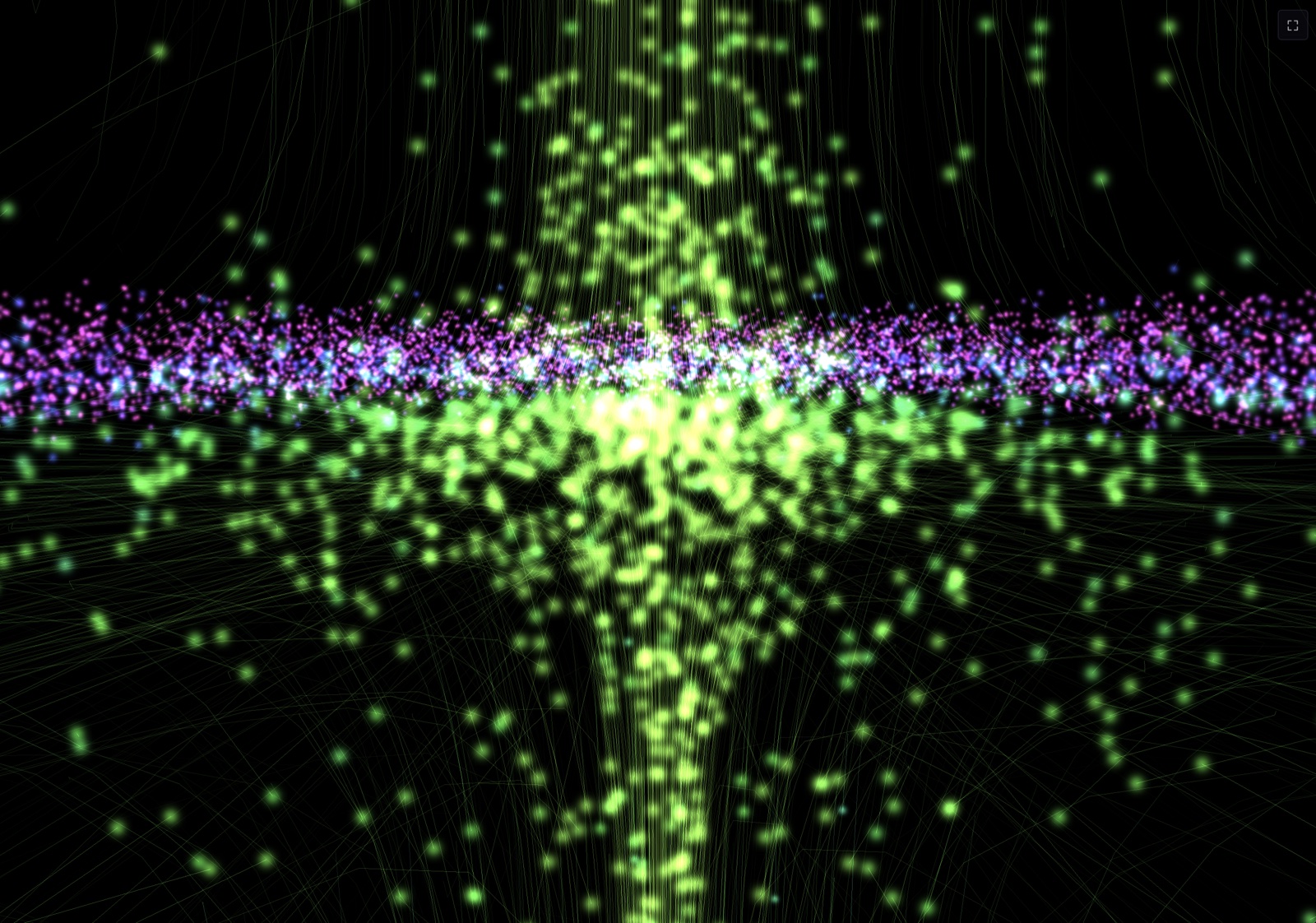
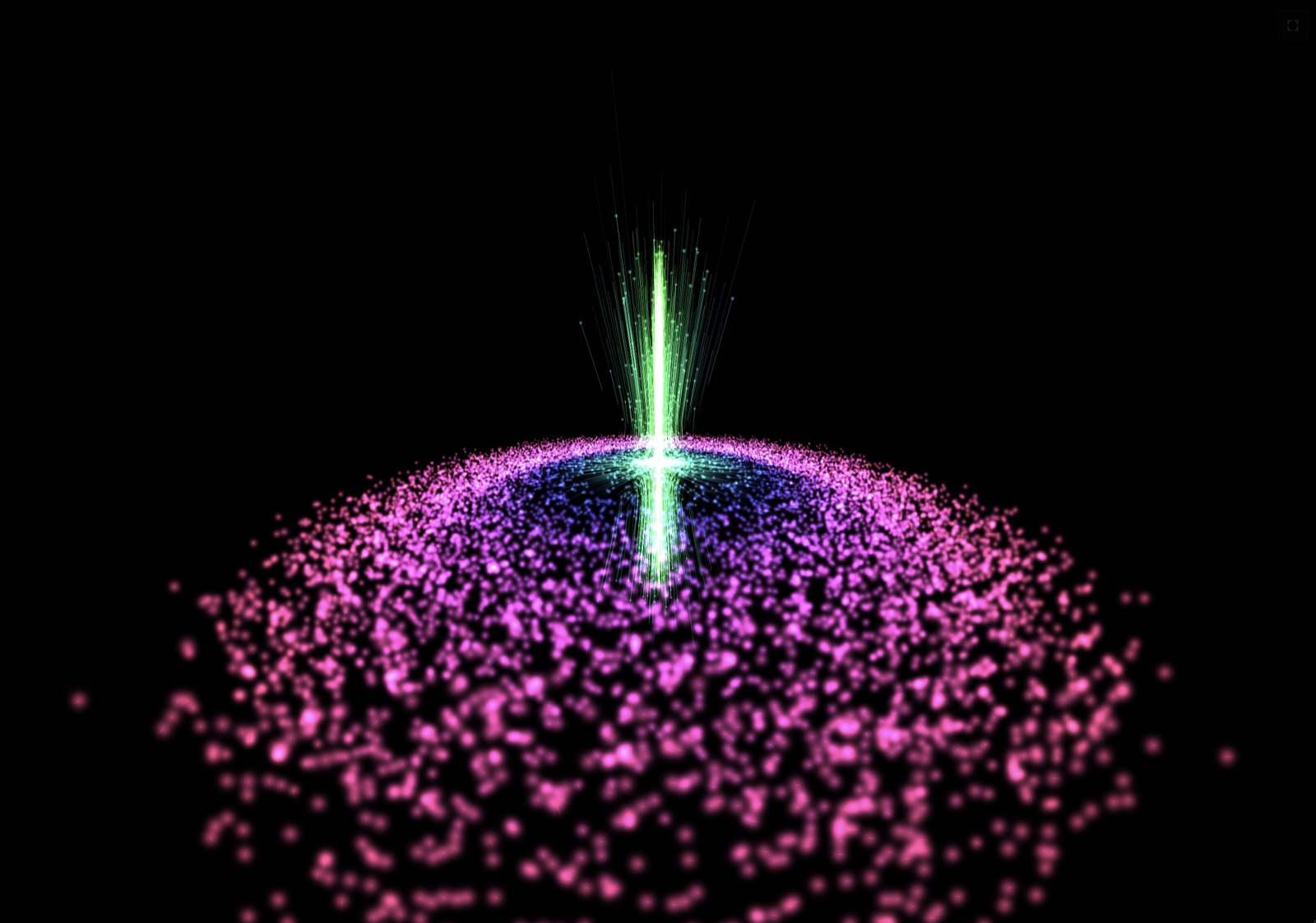
A vortex from the frontier of mathematics. In September 2026, OpenAI published a proof that a gently pushed fluid can spin itself up to infinite speed in a finite amount of time. This scene shows the shape of that vortex, beside two exact whirlpools that help explain it.
The Navier–Stokes equations are Newton's law written for every drop of a fluid: pressure pushes, stickiness rubs, and the fluid cannot be squeezed. Whether their solutions always stay smooth is one of the Clay Institute's million-dollar Millennium Prize problems.
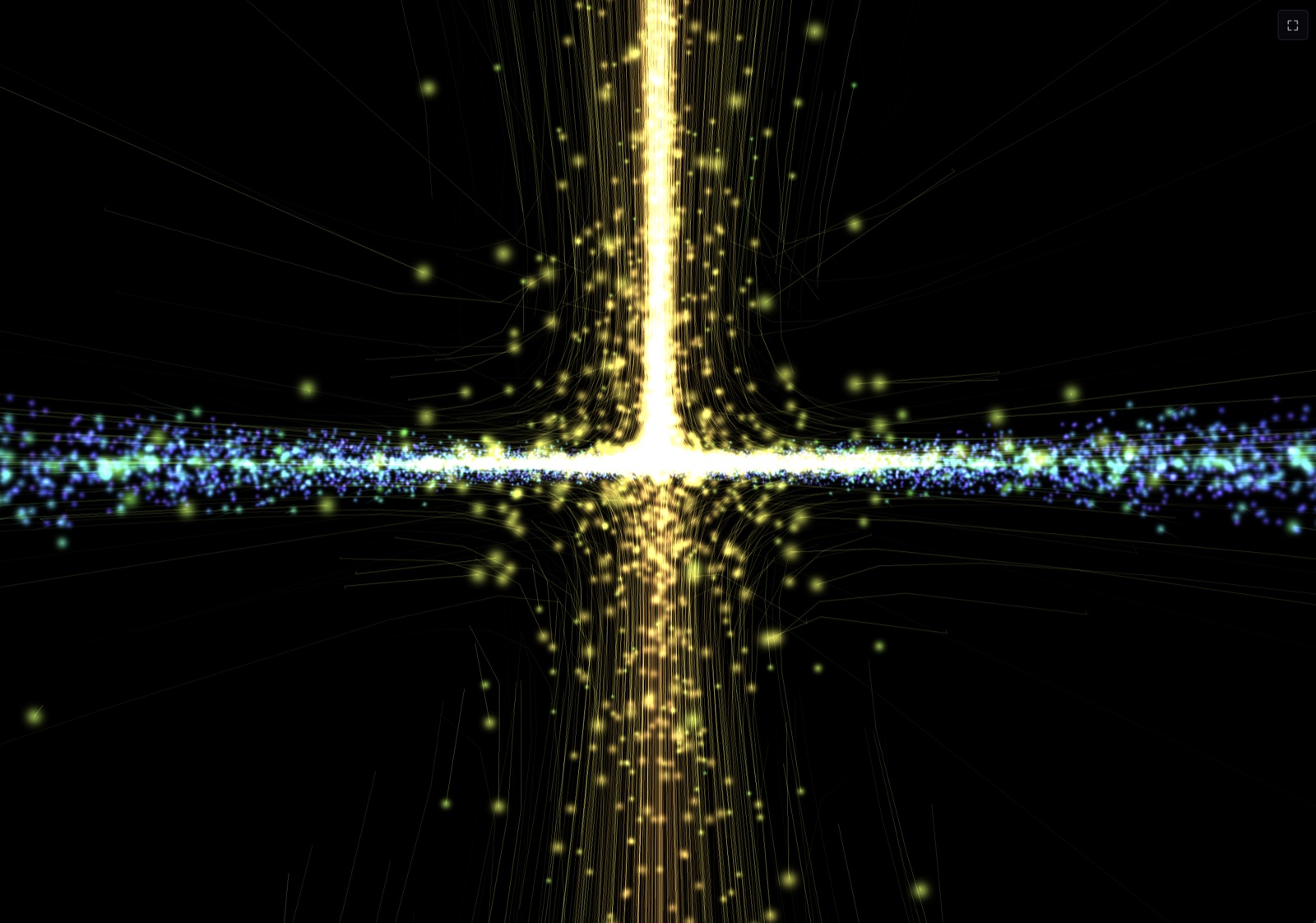
The blowup scene follows the construction OpenAI published on September 8, 2026. Fluid is drawn toward a vertical axis along a narrow waist, and a thin spinning sheet just below the middle turns faster and faster as it closes in, like a skater pulling in their arms. The fluid escapes up and down the axis in jets that spread into an hourglass. As the time left runs out, the whole vortex shrinks toward a single point and its speed grows without limit, even as the energy it carries drains away.
A note on honesty. The proof covers a fluid with a smooth outside push, the forced problem; whether a fluid left alone can blow up is still open. As of September 2026, the proof has been checked by computer but not yet peer reviewed, and credit for the idea is disputed. The scaling laws, the coordinates, and the flow the paper writes down near the axis are drawn exactly. The constants the proof leaves unspecified, and the distances, which really span many orders of magnitude, are illustrative.
Two companion scenes are exact. The collapsing Burgers vortex shrinks and speeds up at the very same rates, but it is powered by stretching imposed from infinitely far away, so it is an analogue rather than the proof's mechanism. The classic Burgers vortex is the healthy counterpart: stretching concentrates its spin, stickiness spreads it out, and the two balance forever.
The Math
$$\partial_t \mathbf{u} + (\mathbf{u}\cdot\nabla)\mathbf{u} - \nu\,\Delta\mathbf{u} + \nabla p = \mathbf{f}, \quad \nabla\cdot\mathbf{u} = 0$$
The incompressible Navier–Stokes equations with an outside force \(\mathbf{f}\). The blowup theorem builds a smooth, localized force, and a flow that starts at rest, whose top speed becomes infinite at time one.
$$\tau = 1 - t, \quad \ell_r \asymp \tau^{1/2}, \quad \ell_z \asymp \tau^{1/2 - h}, \quad |u_\theta|, |u_z| \asymp \tau^{-1/2-h}, \quad 0 < h < \tfrac{1}{100}$$
How the core scales as the time left, \(\tau\), shrinks: its width like \(\sqrt{\tau}\), its height slightly more slowly, and its spin and jet speed without bound. The small exponent \(h\) must stay below one hundredth.
$$q - z^2 q^{2h} = \tau, \quad \eta = z\, q^{-(1/2-h)}, \quad X = \frac{r^2}{2q}, \quad u_\theta = q^{-(1/2+h)} E(X, \eta)$$
The paper's own coordinates. Because \(q\) grows with height, the region the vortex fills pinches at the middle and flares above and below, which is the hourglass you see.
$$U_* = 4\eta + j_0, \qquad \phi \approx \phi_*\, f_0\big(\Lambda X\big), \quad f_0(z) = \frac{2 J_1\big(\sqrt{2z}\big)}{\sqrt{2z}}$$
Near the axis, the paper writes the flow down: an axial strain of \(4\eta\) plus a tiny upward push \(j_0\), and a swirl whose profile follows a Bessel function, the curve of a vibrating drumhead.
$$\partial_t \omega = \alpha\Big(\omega + \frac{r}{2}\,\partial_r \omega\Big) + \nu\, \frac{1}{r}\,\partial_r\big(r\,\partial_r \omega\big)$$
For a stretched vortex, the full equations reduce exactly to this one equation for the spin, \(\omega\). Spiralyst solves it live. With steady stretching it settles into the classic Burgers vortex.
How Spiralyst Lab draws it
Spiralyst Lab does not run a grid fluid simulation, because no grid could ever resolve a singularity. Instead, it evaluates the proof's leading-order velocity field in the paper's own coordinates, and sends up to sixty thousand glowing particles through it, in full 3D, on the same orbit camera as the fractals. The Infinite zoom view draws four nested copies of the vortex, shrinking toward the center and fading in and out, so the collapse keeps going without a loop point; that is honest, because this vortex looks the same at every zoom level. The Burgers scene solves its exact equation live, every frame. Every control is audio-reactive, and the slider guide describes each one. Everything drawn is labeled as exact, illustrative, exaggerated, or schematic.
Included in the free trial.
Did you know?
The vortex in the blowup proof gets faster without limit while the energy it carries drains to zero. Near its axis, the spin follows a Bessel function, the same curve that describes the vibrations of a drumhead.
Get Spiralyst Lab — $24.99/yr 3D Flows overview ← All gallery
Math typesetting on this page is rendered by KaTeX 0.17.0 (MIT).