Feature guide · 3D Flows
3D Flows — fractals are shapes. Flows are motion.
A fourth kind of scene in Spiralyst Lab. Fractals are shapes that react to sound. Flows are movement — water going over an edge, a vortex tightening toward a point — computed from the equations, sent through as tens of thousands of glowing particles you can fly around, and driven by your music. Two scenes at launch: the Navier–Stokes vortex and the waterfall. Both labeled, part by part, for what is exact and what is a sketch.
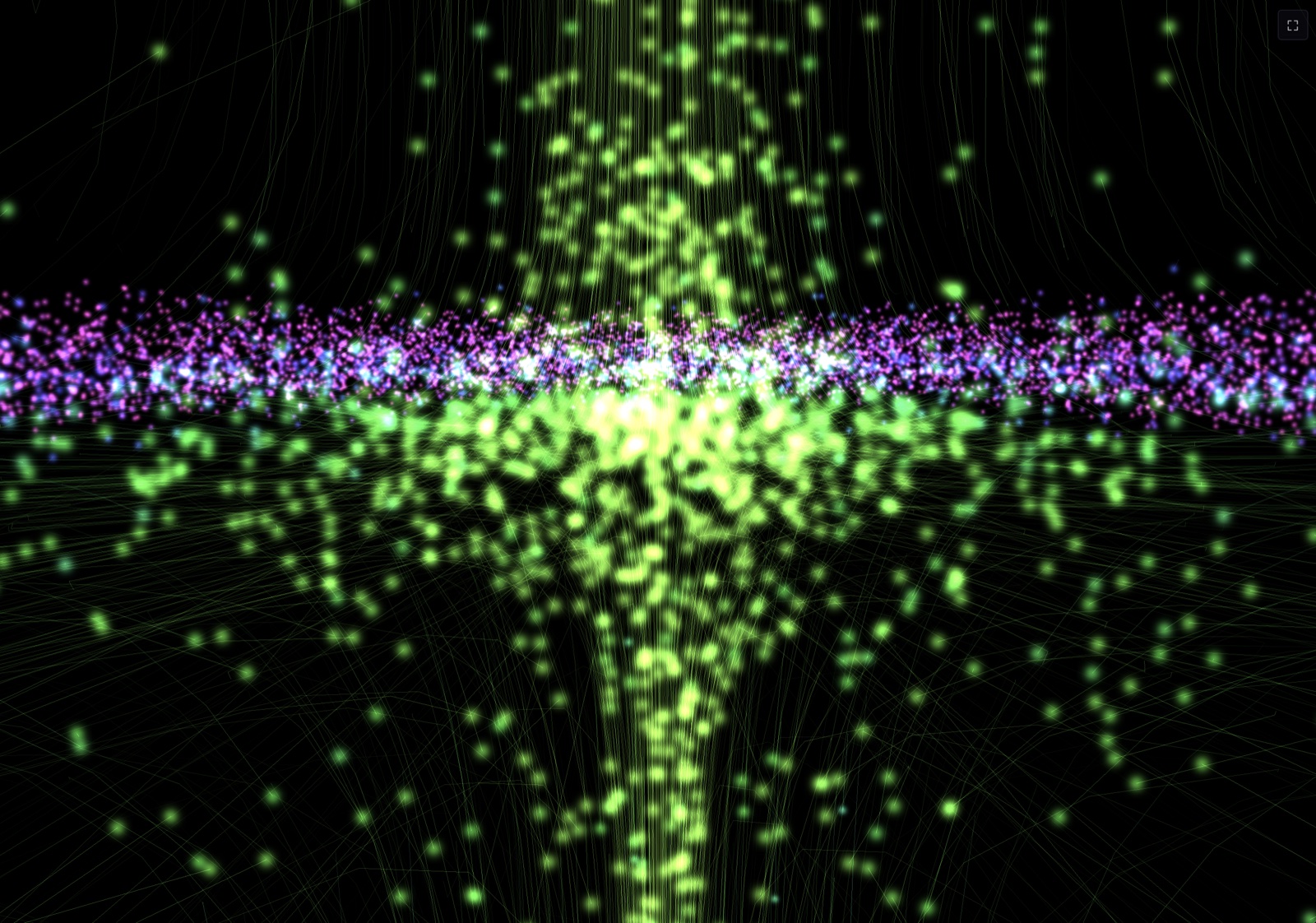
Not shapes that react — motion that is computed
For 31 of Spiralyst Lab's scene types, sound is fuel: the bass pushes the zoom, the hats shimmer the colour, the lead bends the geometry. 3D Flows are different in kind. They start from a description of how a fluid moves — the equations, or an exact solution of them — and send up to sixty thousand glowing particles through that motion in full 3D, with trails, an orbit camera, and every control bindable to your music. It's the first part of the app where every slider is a physical quantity.
The Navier–Stokes vortex
In September 2026, a 166-page proof described a fluid that, pushed gently, spins itself up to infinite speed in finite time. We are not mathematicians and we didn't solve anything; we read the paper, found that it writes down much of the flow near the axis, and drew that: a straining flow that pulls fluid in and fires it out in two jets, a thin spinning sheet shaped by a Bessel function, the hourglass the paper's own coordinates make.
The parts the proof specifies are marked exact. The constants it only calls "sufficiently large" are marked illustrative. Push a slider past the paper's range and the scene says exaggerated. The ripple pulses that balance the flow are marked schematic — their timing is the paper's exact formula; their size and count are yours to set.
Two companion modes put it in context. A textbook collapsing Burgers vortex shrinks at exactly the same rates, driven by stretching from infinitely far away — an analogue, not the proof's mechanism, but every number exact. And the classic Burgers vortex, solved live every frame, where stretching concentrates the spin and viscosity spreads it out, and the two balance forever. Three vortices, one lesson: pull a spinning column longer and it spins faster; the question is whether anything stops it.
The default view is an infinite zoom: the blowup is self-similar, so the scene draws nested copies of it shrinking toward the centre and fading in and out — a seamless loop with no loop point, because the mathematics has none. The full story is in the release post.
Controls: Scene (Blowup core / Collapsing Burgers / Burgers), Tracers (Streamlines / Fluid paths), Collapse view (Infinite zoom / Steady), Collapse clock, Swirl, Axis strain, Collapse speed, Cycle length, Zoom spacing, Twist per octave, Pulses with Pulse gain and Pulse lobes, Sheet sharpness, Jet bias, Stretch — and for Burgers: Strain, Viscosity, Spin, Forcing. Colour by speed, height, distance from axis or spin rate.
The waterfall
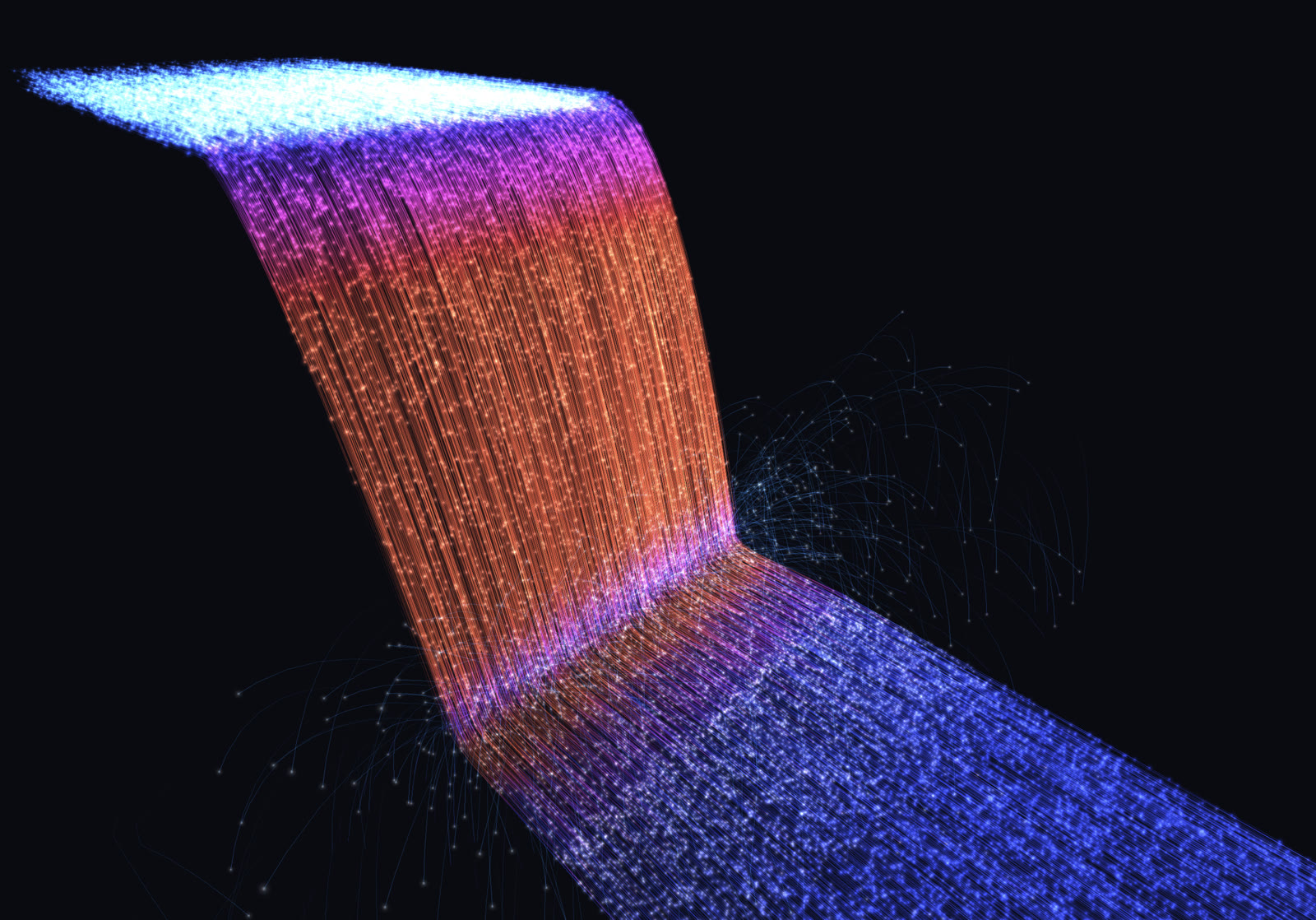
The waterfall is solved, not drawn. Set a flow rate in cubic metres per second per metre of width, a fall height in metres, a bed slope, a roughness. The river draws down toward the lip along the curve open-channel hydraulics predicts. The depth at the brink is the measured ratio hydrologists have used since 1936. The sheet falls ballistically and thins by continuity. Where it lands, the water throws up a hydraulic jump — and its whole character, from a glassy undular ripple to a standing wall of foam, is computed from the Froude number the fall produces, using the same flume measurements engineers use. Raise the tailwater and the jump drowns. Bind the flow rate to your bass and the whitewater moves because the physics moved.
The info bar reports it as you go: the flow rate, the Froude number, the jump's name (undular, weak, oscillating, steady, strong), the energy lost, and the display scale — "1 unit ≈ 2.4 m".
Controls: Flow rate q (0.05–4 m²/s), Channel width (0.5–40 m), Bed slope, Roughness n, Fall height H (1–60 m), Lip angle (±60°), Lip throw, Tailwater, Aeration, Spray, Splash force, Turbulence, Mist drift and size, Foam whiteness, River speed and Pool speed. Colour by speed, Froude number (sub- vs supercritical), air content (water → foam → mist), or height.
Every part labeled
Both scenes carry a truth manifest you can read in Math Mode and query from the automation surface. For the vortex: exact / illustrative / exaggerated / schematic, live — the labels change if you push a slider beyond what the paper allows. For the waterfall: the flow equations, the depths, the jump law and the sheet's trajectory are exact; the brink ratio, the jump forms and the aeration are measured (published experiments); the channel shape and the display scale are illustrative; mist, foam and the roller's particle pattern are schematic. We would rather say "sketch" than let a picture claim more than the mathematics does.
How flows fit with the rest of the studio
- Up to 60,000 particles per scene, soft-glow / dot / ring / star / spark shapes, true-3D trails, gradient backgrounds, the full orbit camera.
- Every control is audio-reactive — bind any slider to a frequency band, the same way fractal sliders bind — and sliders keep their reactivity when you switch scenes.
- Full Math Mode coverage — live formula tile, info card, per-slider guide, and four-section spoken narration for both scenes.
- Safe mode for big scenes (new in 3.6.0) — hold the frame rate by trimming particles or resolution when a frame runs long, with a notice in the control panel; or choose Full power and render exactly what the sliders say. The app also tells you when macOS Low Power Mode is on.
- Same recording and export — File → Record Video captures flows like any scene; the infinite zoom is a seamless loop by construction, so a 15-second clip cuts perfectly.
- Local + private — no telemetry, no network. macOS system-audio or mic capture, as always.
Use it in a classroom
High-school physics — the Froude number. Waterfall on, colour by Froude number. Ask: where does the water change from "fast and shallow" to "slow and deep"? That line is the hydraulic jump, and its position is computed, not placed. Raise the tailwater until the jump drowns.
Fluid mechanics — conjugate depths. Read the Froude number and the jump form off the info bar; check Bélanger's ratio by hand. Then change the fall height and predict the new form before looking.
Calculus / ODEs — what a singularity looks like. Vortex, blowup scene, streamlines view, zoom locked. The speed readout climbs without bound as the collapse clock runs; the energy doesn't. Ask why both can be true.
Math literacy — what a proof does and doesn't say. Vortex, Math Mode open. Which parts of the scene are marked exact and which illustrative, and why would a 166-page proof leave a constant as "sufficiently large"?
Vortex stretching, three ways. Switch Blowup → Collapsing Burgers → Burgers. Same mechanism; in one, viscosity wins; in one, an outside stretch wins; in one, the fluid's own flow does.
Use it in the room
- The living-room screen. Pick the vortex, put on an album, leave it. The collapse never repeats.
- The headline, explained. Vortex on, Math Mode open, narration playing: what the September 2026 result is, what it isn't, and what you're looking at — in five minutes, on a projector.
- Live visuals with a reason. Flow rate on the kick: the whitewater marches with the bass because the conjugate depth moved. Pulses on the hats.
- A loop that actually loops. Record 15 seconds of the infinite zoom for a square social clip.
What we don't claim
Spiralyst Lab does not simulate the Navier–Stokes equations, and it does not contain or verify the proof. It draws the flow the paper — and two exact solutions — describe, and sends particles through it; a grid simulation could not show a singularity at all. The September 2026 result concerns the forced problem, is not peer reviewed, has not been accepted by the Clay Institute, and is the subject of a priority dispute. The waterfall is solved from published hydraulics and labeled where it isn't. If you spot something we got wrong, tell us.
Where to go from here
- Read the 3.6.0 release post — the vortex, the research, and the caveats, at length.
- See the Math Mode page — both flow scenes carry the same live-formula overlay as every fractal and scope.
- Get Spiralyst Lab — the Navier–Stokes vortex is in the free trial; the waterfall and everything else is $24.99 for a one-year license, direct download. 3D Flows ship in v3.6.0 for macOS 14.4+.