Feature guide · 3D fractals
3D fractals — shapes you can fly through.
Thirteen ray-marched, three-dimensional fractals built into Spiralyst Lab — the Mandelbulb and Mandelbox, the Menger sponge, a quaternion Julia set, three kaleidoscopic crystal solids, a pseudo-Kleinian web, the Sierpinski tetrahedron, a 3D Apollonian foam, two minimal surfaces, and a hybrid that morphs between bulb and box. Each is drawn fresh from its formula every frame, framed by a camera you can orbit, lit by a light you can move, and bendable by your music.
Not pictures of fractals — the fractals themselves
For the 2D types in Spiralyst Lab, the fractal is a drawing on a flat canvas. The 3D types are places. There are no models to load and no animation baked in advance: every frame, for every pixel, the app sends a ray from the camera into the scene, and the fractal's own formula — a distance estimate — tells that ray how far it can safely travel before it might touch the surface. It steps, asks again, steps again, and stops when it lands. That technique is called ray marching, and it's why these shapes stay crisp however close you fly: the surface is computed, not stored.
It also means every slider is a dial on the real formula. Raise the Mandelbulb's power and its lobes multiply. Push the Mandelbox's scale negative and it turns inside out into rooms within rooms. Slide the quaternion Julia set's slice and you're cutting a different cross-section through a four-dimensional object. And because any slider can follow your music, the shape itself can move when the song does.
The 13 types
Mandelbulb — the 3D Mandelbrot
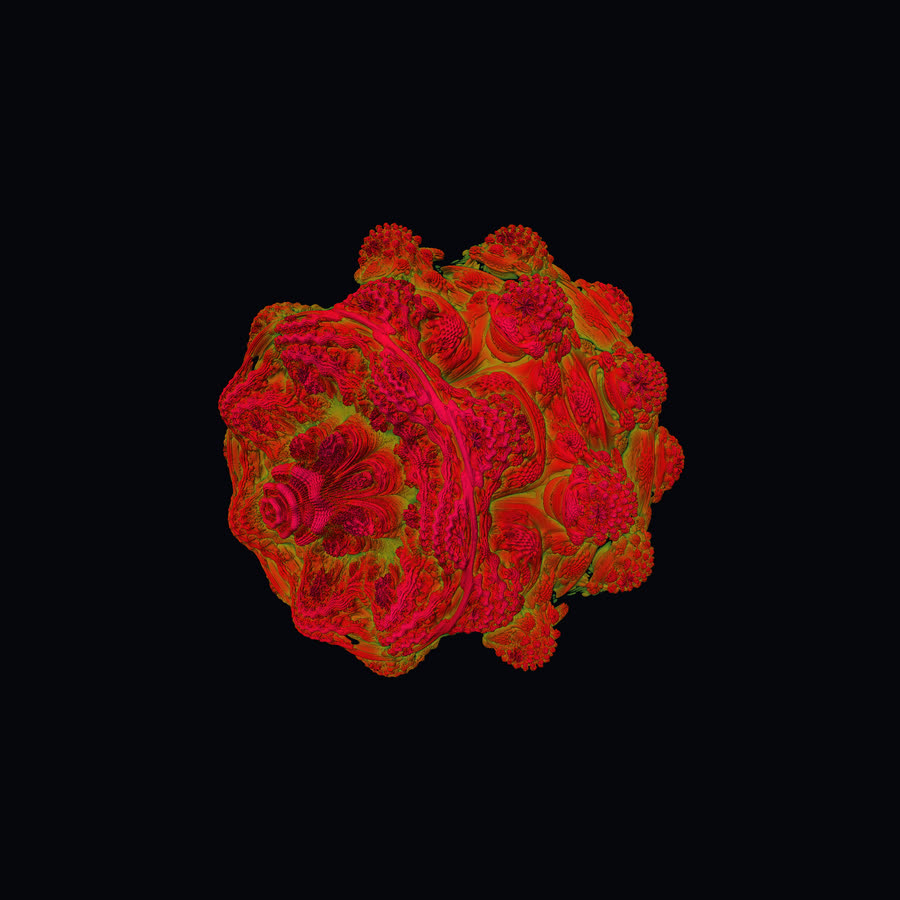
The most famous answer to "what would the Mandelbrot set look like in three dimensions?" Points are raised to a power in spherical coordinates and iterated, and the ones that stay bounded form an organic, bulbous planet dense with surface detail that rewards flying in close. Power is the headline dial — 8 is the classic shape, lower is smoother, higher grows more lobes; Iterations add surface detail. Included in the free trial.
Controls: Power (2–16), Iterations, Bailout, Surface ε, Ray steps. With music: Power on the bass makes the whole planet swell and sprout lobes on every hit; a little field-of-view on the kick adds a lunge toward the camera.
Mandelbox — impossible architecture
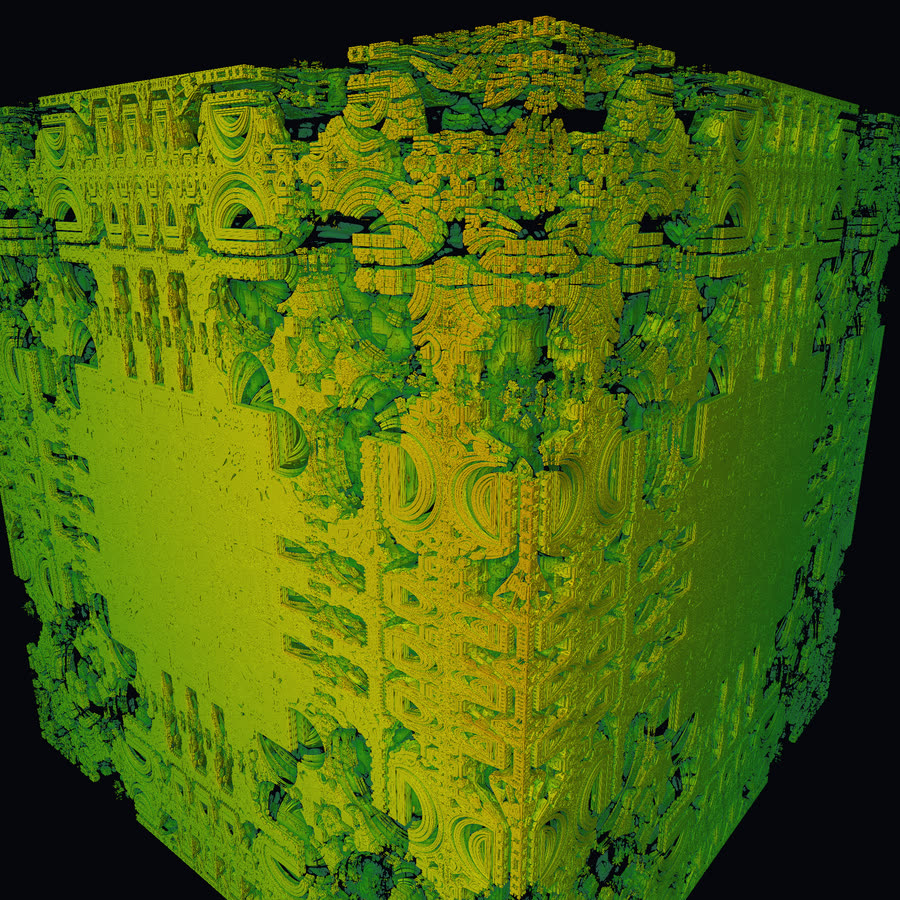
The Mandelbox folds space through a box and a sphere on every iteration, then scales it, stacking the folds into endless nested boxes, corridors and balconies — a fractal you want to walk through rather than look at. Scale reshapes the whole structure; small changes flip it between open lattices and dense blocks, and negative values (down to −1.5) turn it inside out into vast room-within-room interiors.
Controls: Scale (−1.5 to 3), Iterations, Surface ε, Ray steps. With music: Scale on a slow band makes the architecture rebuild itself over a phrase; camera Distance on the kick pushes you in and out of the corridors.
Menger sponge — infinite surface, zero volume
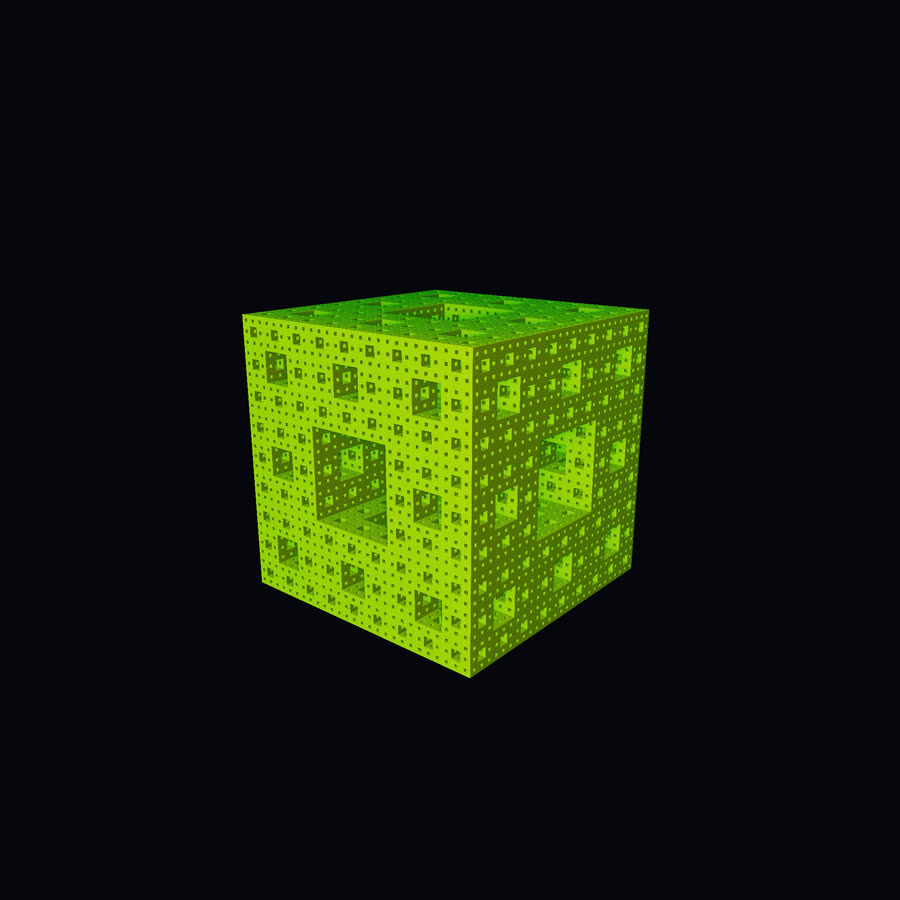
A cube split into 27 smaller cubes, the centre and face-centres thrown away, and the same done to the 20 that remain — forever. The result has ever more surface and ever less volume; every face is a Sierpinski carpet and every edge a Cantor set. Iterations (3 to 6) is the only shape control: there is no power and no bailout, just clean recursion.
Controls: Iterations (3–6), Surface ε, Ray steps. With music: Iterations on a band makes the sponge gain and lose whole levels of holes in steps — one of the few 3D sliders that moves in discrete jumps, which reads beautifully on drums.
Quaternion Julia — a 4D fractal, sliced
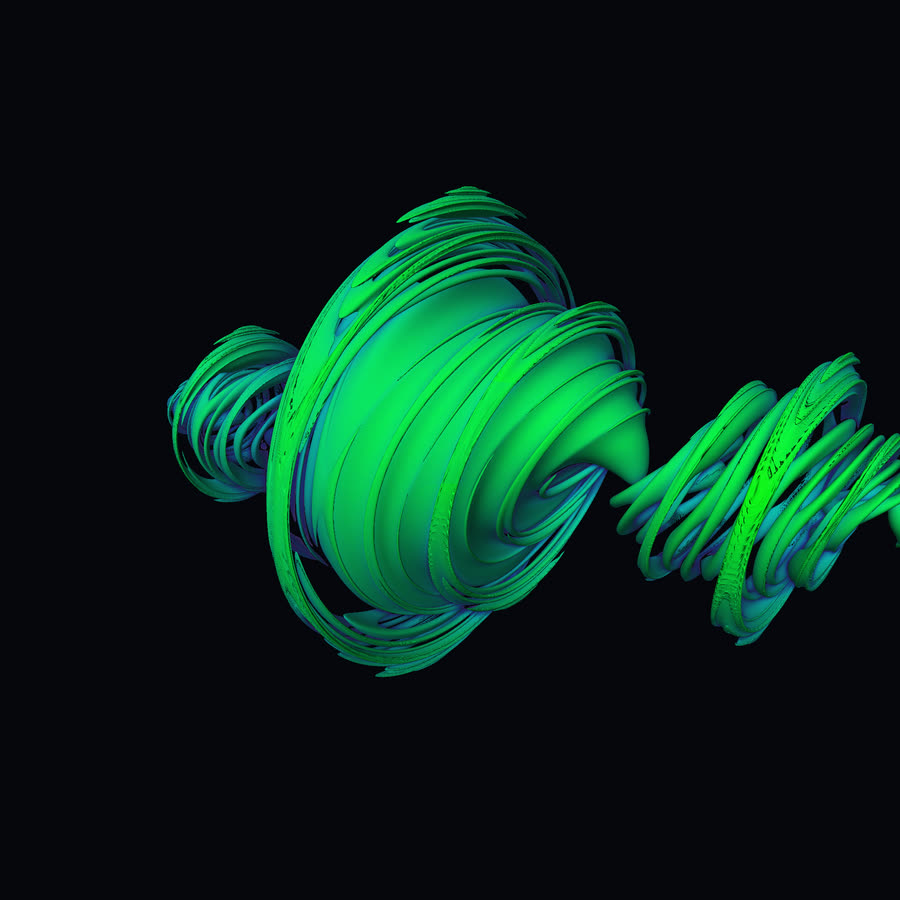
The Julia-set iteration run in quaternions — four-dimensional numbers — with a three-dimensional slice taken through the result, like cutting a slab from a loaf. The surfaces are smooth and liquid-metal. The four components of the seed c reshape the set, and Slice w chooses where the cut falls, so sliding it morphs the whole cross-section.
Controls: c.x, c.y, c.z, c.w, Slice w, Bailout, Iterations, Surface ε, Ray steps. With music: Slice w on a slow band is the showpiece — the shape keeps melting into new forms because you're moving through a fourth dimension.
KIFS tetra — the crystal
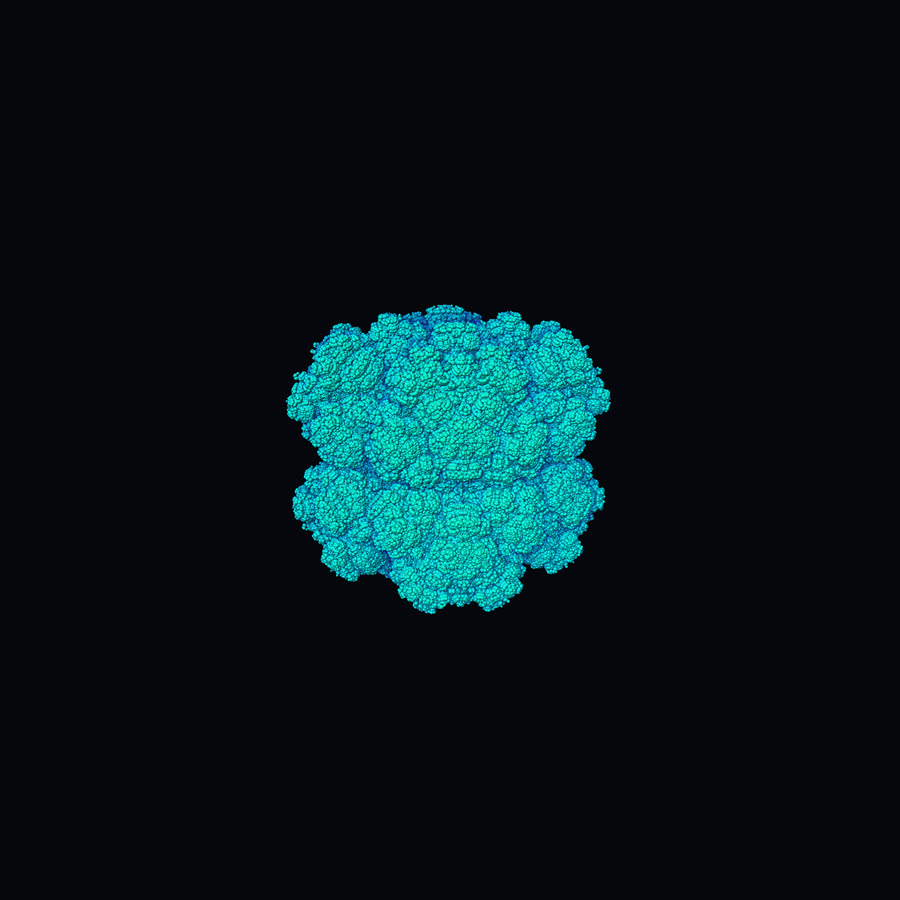
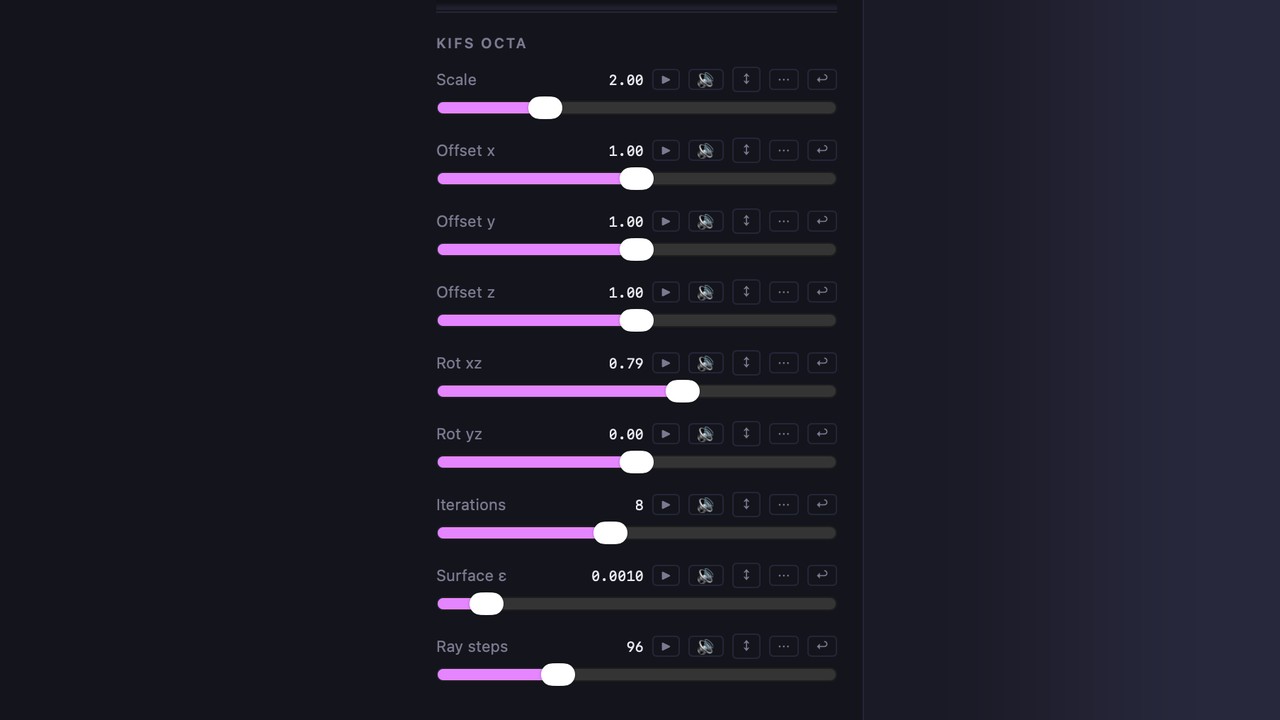
A kaleidoscopic fractal grows by folding space through mirror planes, scaling it inward, and repeating — here tuned to read as tetrahedral, crystalline and snowflake-like, as if it grew inside a geode. Scale, the three Offsets and two Rotations reshape the crystal completely; small rotation tweaks flip it between a tight gem and an airy scaffold.
Controls: Scale, Offset x / y / z, Rot xz, Rot yz, Iterations, Surface ε, Ray steps. With music: Rot xz on a mid band sets the crystal turning inside itself — the folds re-align on every note.
KIFS octa — the mineral
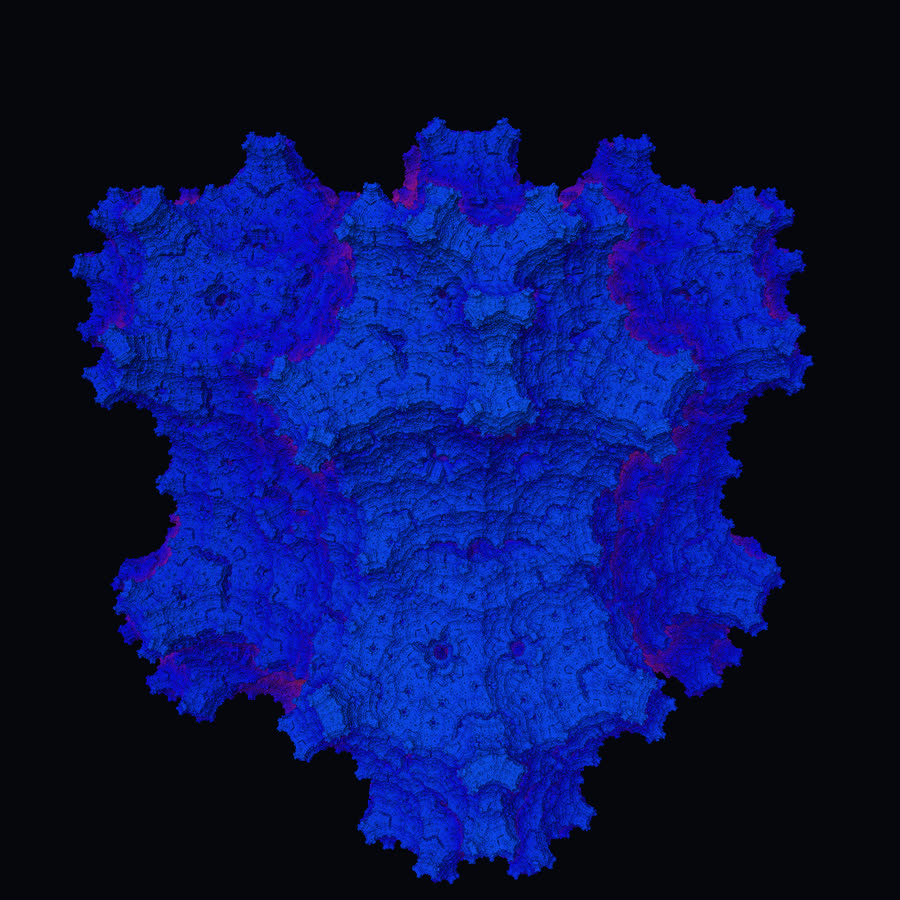
The same kaleidoscopic engine, turned to read as a denser, eight-fold mineral growth — where the tetra is a snowflake, the octa is a cut block of crystal. The rotation controls do most of the symmetry work here, so they're especially dramatic.
Controls: as KIFS tetra. With music: Rot yz on the upper mids; Scale on the bass for a crystal that pulses outward.
KIFS cube — the circuit board
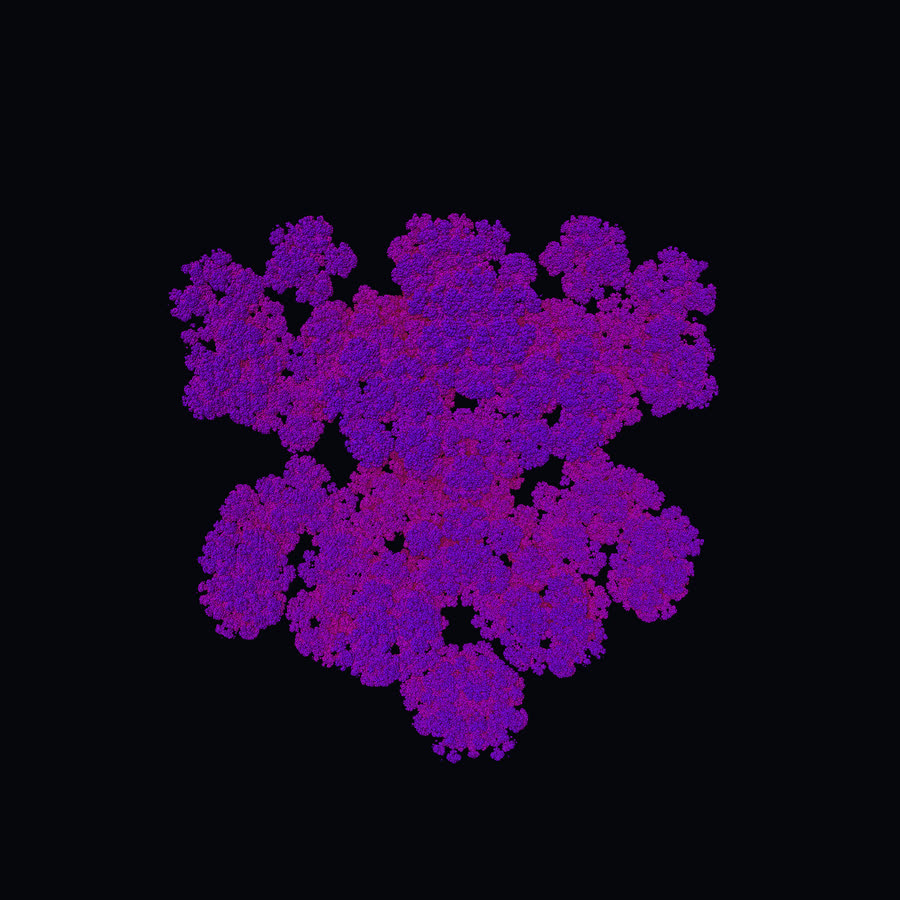
The cube preset tunes the kaleidoscopic engine toward boxy, right-angled, circuit-board recursion — the inside of a microchip that no one designed, only iterated. Keep a little rotation in: a perfectly flat fold renders as a plain solid, and a small turn reveals the circuitry inside.
Controls: as KIFS tetra. With music: a slow ▶ on Rot xz for drift, Scale on the kick for the circuitry to snap open.
An honest note on all three KIFS types: in Spiralyst Lab the tetra, octa and cube are one kaleidoscopic algorithm with three sets of starting values, not three different fold geometries. Change the scale, offset and rotation and any of the three can become the others.
Pseudo-Kleinian — the web
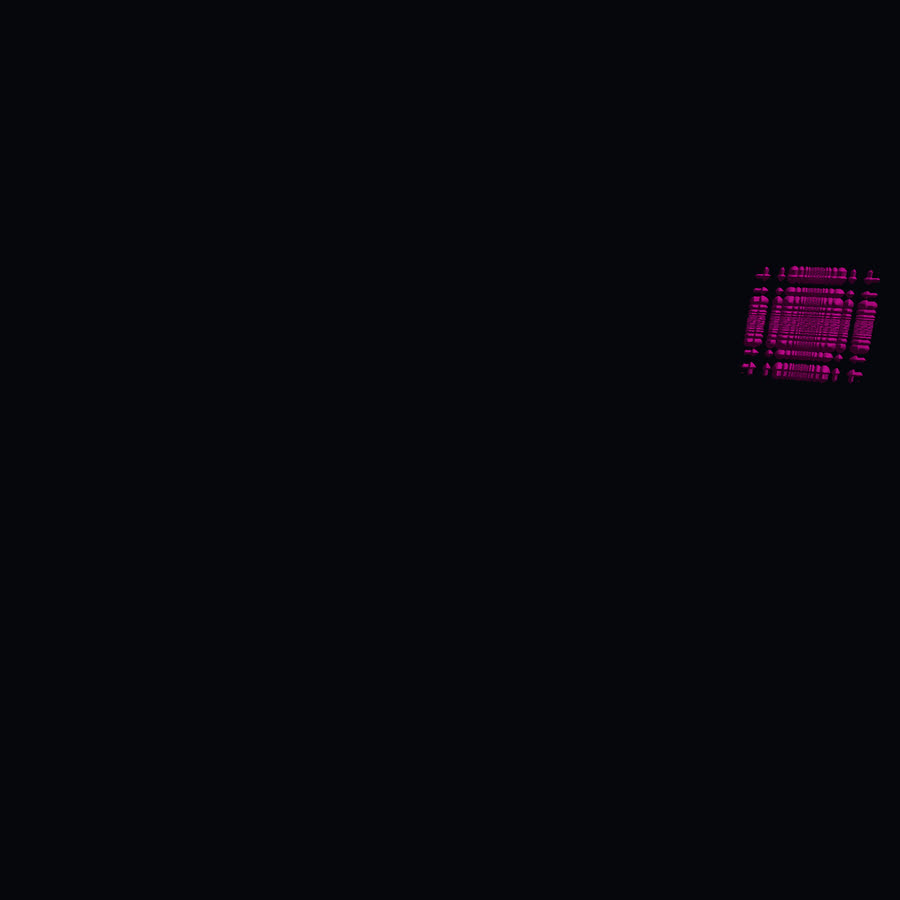
A fractal that evokes the infinitely reflected limit sets of Kleinian groups while staying light enough to fly through live. It is sparse and web-like, spreading organic strands across space like coral, neural tissue or the cosmic web. Scale and Sphere fold set how sparse or tangled the web becomes; it's big, so it opens framed from far back — orbit with a little fog and the far strands recede.
Controls: Scale, Sphere fold, Iterations, Surface ε, Ray steps. With music: Sphere fold on a band makes the web knit and unknit; fog on a slow band pulls the distance in and out.
Sierpinski tetrahedron — dimension exactly two
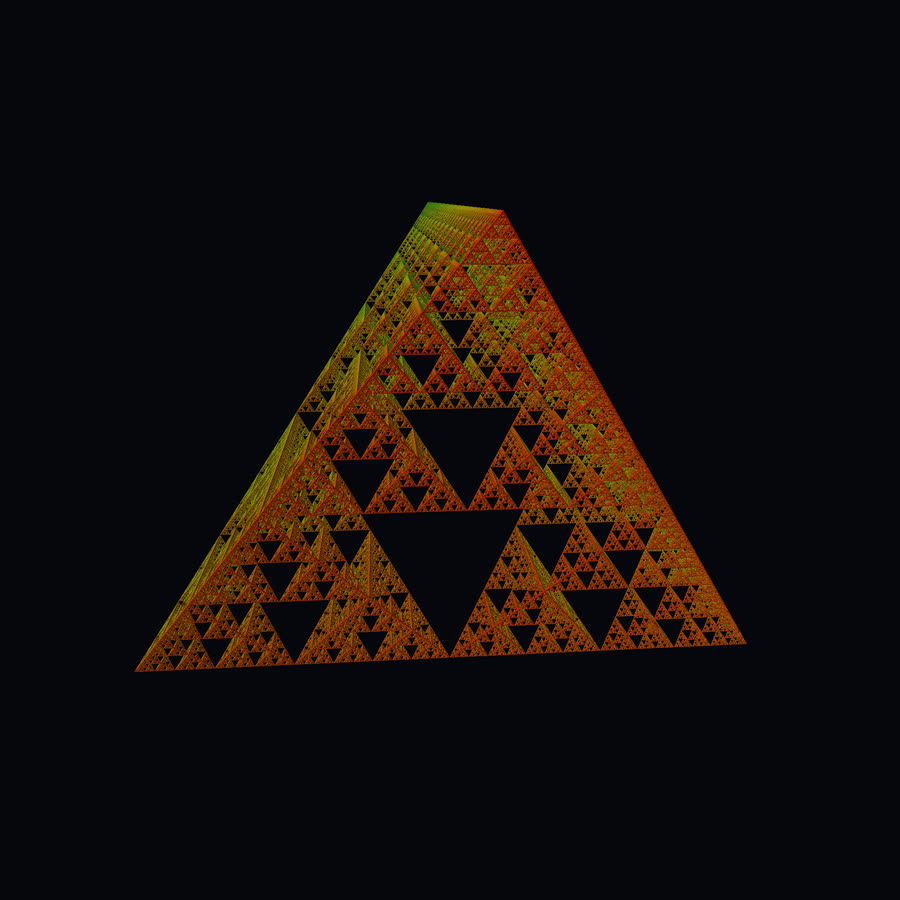
The three-dimensional Sierpinski gasket: a tetrahedron split into four corner copies with the middle thrown away, again and again. Its volume melts to nothing while it stays connected — a skeleton of fractal dimension exactly two. At the default Scale of 2 with no Twist it is the exact classical shape; add Twist and the levels shear into a spiral staircase.
Controls: Scale, Offset X / Y / Z, Twist, Iterations, Surface ε, Ray steps. With music: Twist on a band winds and unwinds the staircase — about as clear a picture of "self-similar" as you'll find.
Apollonian 3D — bubbles within bubbles
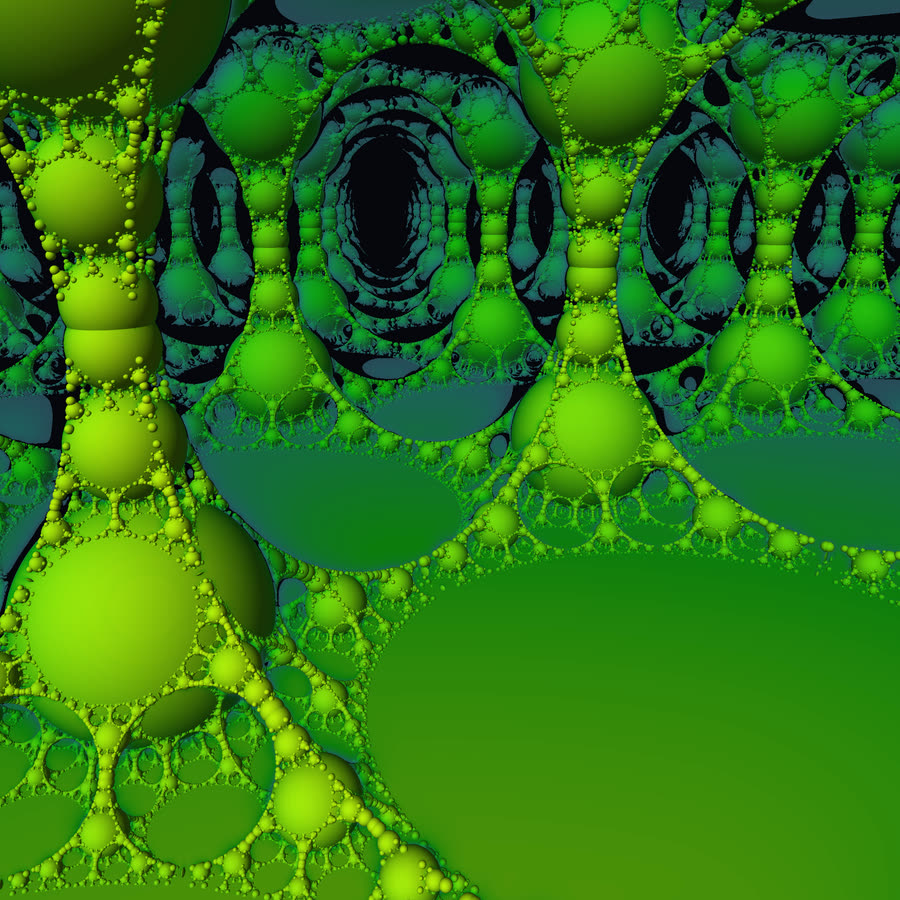
Sphere-packing lifted into three dimensions — bubbles nested within bubbles, filling space in an effervescent foam. It's built by repeated spherical inversion, and Inversion K is the headline control: packing density follows from K and the iteration count. It is spread out, so it opens framed from far back; a touch of glow makes the small spheres sparkle as you orbit.
Controls: Inversion K, Iterations, Surface ε, Ray steps. With music: Inversion K on a band makes the whole foam re-pack itself on the beat.
TPMS Schwarz P — the soap-film lattice
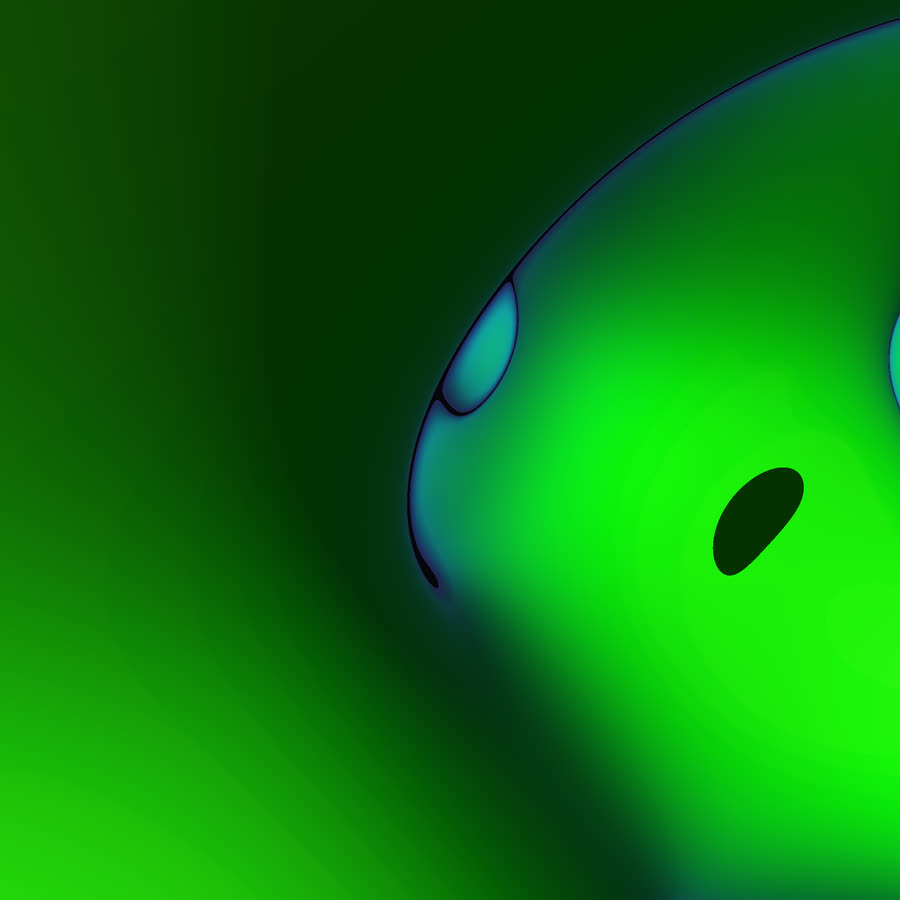
A triply-periodic minimal surface — an endless soap-film membrane, saddle-shaped at every point, that divides space into two interlocking channels. The whole structure comes from one short equation of three cosines. Frequency sets the repeat period and Thickness gives the zero-thickness mathematical surface a solid shell you can see.
Controls: Frequency, Thickness, Surface ε, Ray steps. With music: Thickness on a pad or bass band makes the membrane breathe; Frequency on a slow band zooms the lattice's own scale.
TPMS Gyroid — the butterfly-wing surface
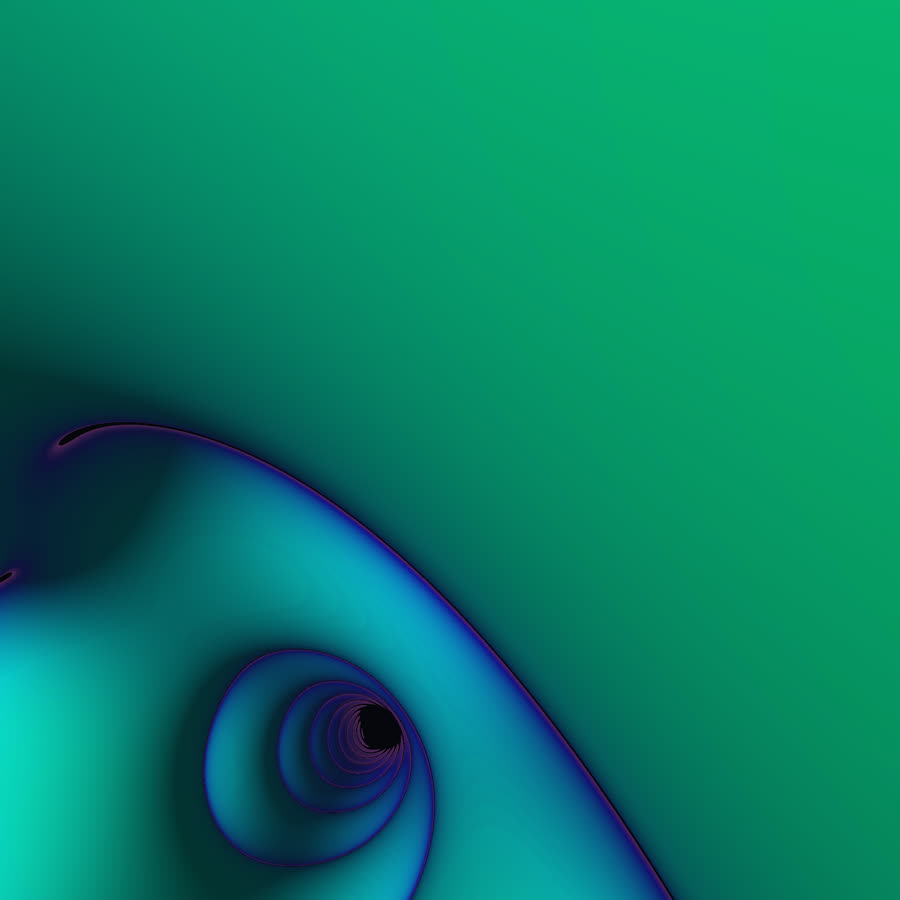
A minimal surface with no straight lines and no mirror symmetry, weaving through space as a single continuous channel that never crosses itself — the shape in 3D-printing infill and in the structural colour of some butterfly wings. Same controls as Schwarz P: Frequency for the period, Thickness to fatten or thin the weave. The continuous channel makes for endless flow-through shots. Included in the free trial.
Controls: Frequency, Thickness, Surface ε, Ray steps. With music: Thickness on the bass for a membrane that swells with the kick.
Hybrid (Bulb↔Box) — the chimera
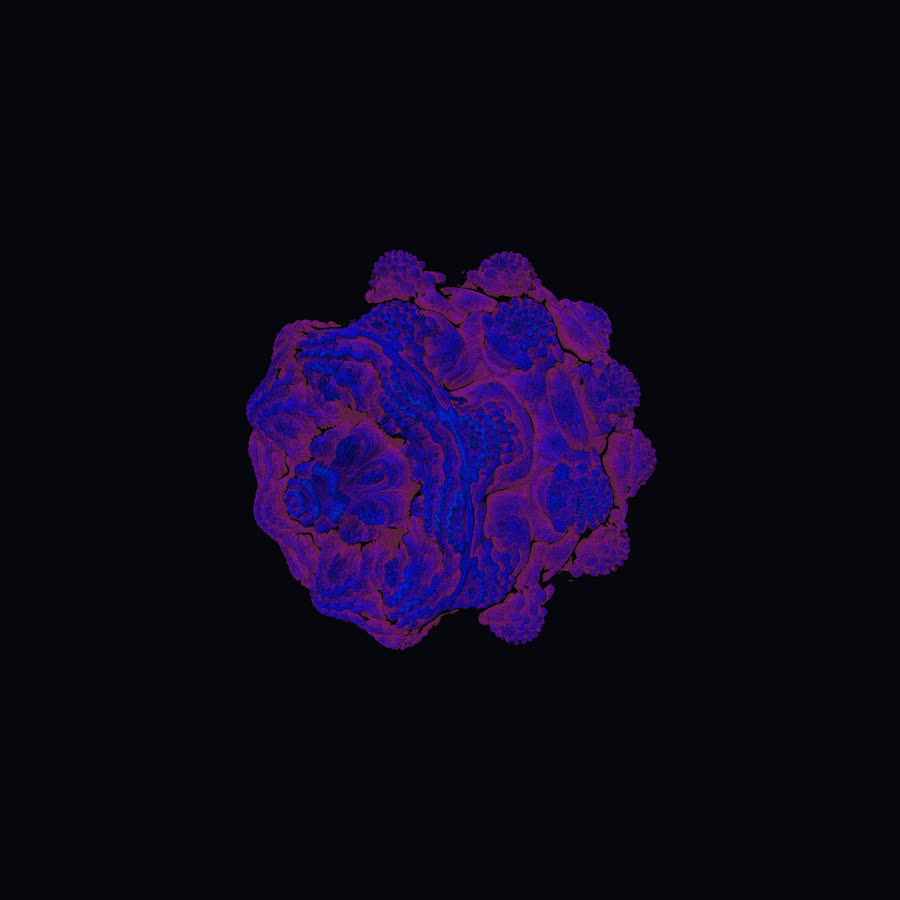
One dial, Blend, slides continuously from the Mandelbulb's organic skin to the Mandelbox's faceted architecture; stop anywhere between for chimeras that belong to neither parent. Bulb power and Box scale still shape their halves. An honest note: the hybrid mixes the two shapes' distance estimates rather than their iterations, so the in-between forms are an artistic blend, not a new fractal in the strict sense — the imperfection is part of the charm.
Controls: Blend (Bulb↔Box), Bulb power, Box scale, Bulb bailout, Iterations, Surface ε, Ray steps. With music: Blend on a slow band and the whole object transmutes from bulb to box and back.
The controls every 3D fractal shares
- Orbit camera. Drag on the canvas to orbit; scroll to move closer or further. Camera sliders — Yaw, Pitch, Distance and FOV (field of view) — do the same precisely, and each type opens framed at a distance that suits it (the sparse ones start further back).
- Lighting. One light you can swing around the shape with Light yaw and Light pitch, plus Ambient (how dark the shadows get), Fog density (depth haze that makes far detail recede) and Glow falloff (a soft inner glow that lifts fine detail).
- Colour. Hue start, Hue span, Saturation and Lightness colour the surface, and the background colour fills the empty space around it — the same colour model the 2D types use.
- Detail. Every type has Surface ε (how close a ray must come to count as touching the surface — smaller is sharper) and Ray steps (how many steps each ray may take — more reaches deeper crevices). Both trade crispness for smoothness of motion.
- Everything moves. Every slider — the fractal's own, the camera, the light — has ▶ to animate it back and forth on its own, and a speaker button to bind it to a band of your music: its loudness, its pitch, where its tone sits, or its hits. A slow ▶ on camera Yaw is an instant turntable.
- Reset and reseed. ⤺ Reset puts the current type back to its defaults in one undoable step; the 🎲 seed button rolls a fresh variation (the KIFS solids use fixed starting shapes, so the seed doesn't apply to them).
How 3D fractals fit with the rest of the studio
- 27 fractals, 4 scopes, 2 flows. The 13 3D fractals sit in the type dropdown under their own 3D Fractals group, beside 14 2D fractals, 4 Scopes and 2 3D Flows — 33 selectable render types in all.
- Same audio reactivity — the same frequency bands, auto-reactivity and per-slider binding as every other scene, from your Mac's system audio or the microphone.
- Full Math Mode coverage — each type has the live formula tile, the textbook-depth info card with its history, the hero formula, a plain-English slider guide, and four-section spoken narration.
- Safe mode for heavy scenes — ray-marched fractals lean on your Mac's graphics chip. In Safe mode the app lowers the render resolution when a frame runs long and gives it back when there's headroom, with a notice in the control panel; Full power renders exactly what your sliders say. The app also tells you when macOS Low Power Mode is on.
- Recording and stills — File → Record Video captures 3D fractals as MP4, MOV or WebM at up to 4K; Save PNG re-renders the frame at the size you choose (up to 16,384 pixels wide, with a print PPI), not an upscale of the screen. If a scene is too heavy to record smoothly, the app tells you before it starts.
- Presets keep the whole scene — type, sliders, colour, camera, lighting and every audio binding — so a look you build is a look you can recall.
Use it in a classroom
A few starting points for educators.
Geometry — infinite surface, zero volume. Menger sponge, Iterations at 3. Each level keeps 20 of 27 smaller cubes. Ask the class what fraction of the volume survives each step, and what happens to the surface as holes open. Step up to 4, 5, 6 and let them check their prediction on screen.
Fractal dimension — a solid shadow from an almost empty shape. Sierpinski tetrahedron, Twist at 0. Four copies at half size: its dimension is exactly 2. Orbit to look straight down one face and ask why something with no volume can still cast a complete triangular shadow.
Complex numbers → quaternions — slicing a fourth dimension. Quaternion Julia, Math Mode on. A flat Julia set lives in the complex plane; this one lives in four dimensions, and what you see is a 3D slice. Slide Slice w and compare it to a CT scanner stepping through a body one slice at a time.
Materials science — minimal surfaces. Gyroid, then Schwarz P. Thicken the membrane until it looks like 3D-printing infill; thin it until it's a soap film. Ask where else two interlocking channels that never meet might be useful, then read the info card on butterfly-wing colour.
Symmetry — one algorithm, three crystals. Open KIFS tetra, octa and cube in turn and compare their sliders: they're the same. Challenge a group to turn the cube into something tetra-like by changing only scale, offset and rotation.
Why power 8? Mandelbulb, Power from 2 to 16. The shape everyone knows uses 8 because its discoverers tried many powers and liked 8 best. Let students pick their own favourite and defend it.
Use it as a hobbyist or a performer
- Fly-throughs. Scroll into the Mandelbox until the corridors surround you, add fog, set a slow ▶ on Yaw, and leave it running with an album.
- Live visuals with weight. 3D fractals are the big, slow, stage-filling shapes: Power on the bass for a Mandelbulb that heaves with the kick, Blend on a long band for a hybrid that transmutes through a whole song, Thickness on the pads for a gyroid that breathes.
- Lighting as a performance. Bind Light yaw to a mid band and the shadows sweep across the surface on every phrase — the shape stays still while its meaning changes.
- Prints. Frame a still, save a PNG thousands of pixels wide with a print PPI, and it's re-rendered at that size, crisp to the edge.
- Loops for social. Record a square clip of a slow orbit; the shape is live, so no two recordings are the same.
Try it free
Two of the thirteen are in the free trial: the Mandelbulb and the TPMS Gyroid, with the full camera, lighting, audio reactivity and Math Mode, plus a bundled Mandelbulb demo scene. The other eleven are visible in the type menu with a lock until you register. Saving images and video needs a license.
What we don't claim
These are fractal renderings, not 3D models: Spiralyst Lab doesn't export meshes or files for 3D printing, and vector (SVG) export is for 2D types only. The lighting, fog and glow are how we choose to draw the surface, not part of the fractal's mathematics. Three types take honest shortcuts, and their info cards say so: the three KIFS solids are one algorithm with different starting values; Apollonian 3D is built by sphere inversion rather than exact sphere-packing arithmetic; and the Hybrid blends two shapes' distance estimates rather than iterating a true hybrid formula. The pseudo-Kleinian fractal evokes Kleinian limit sets rather than computing one. If you spot something we got wrong, tell us.
Privacy and offline use
3D fractals work exactly the same way the rest of Spiralyst Lab does. The audio is captured live on your Mac and analyzed in the moment, never recorded or transmitted. There is no telemetry, no external network, no account. Read the privacy promise for the rest of the story.
Where to go from here
- Browse the gallery — every 3D type has its own page with motion previews, the full write-up, the math and a "did you know".
- Read Choosing & shaping fractals — the tutorial on picking a type and bending it with its sliders.
- See the Math Mode page — the live formula overlay every 3D fractal carries.
- Get Spiralyst Lab — the Mandelbulb and Gyroid are in the free trial; all 13 3D fractals, and everything else, are $24.99 for a one-year license, direct download, for Apple Silicon Macs on macOS 14.4 or later.