3D fractal
Hybrid (Bulb↔Box)
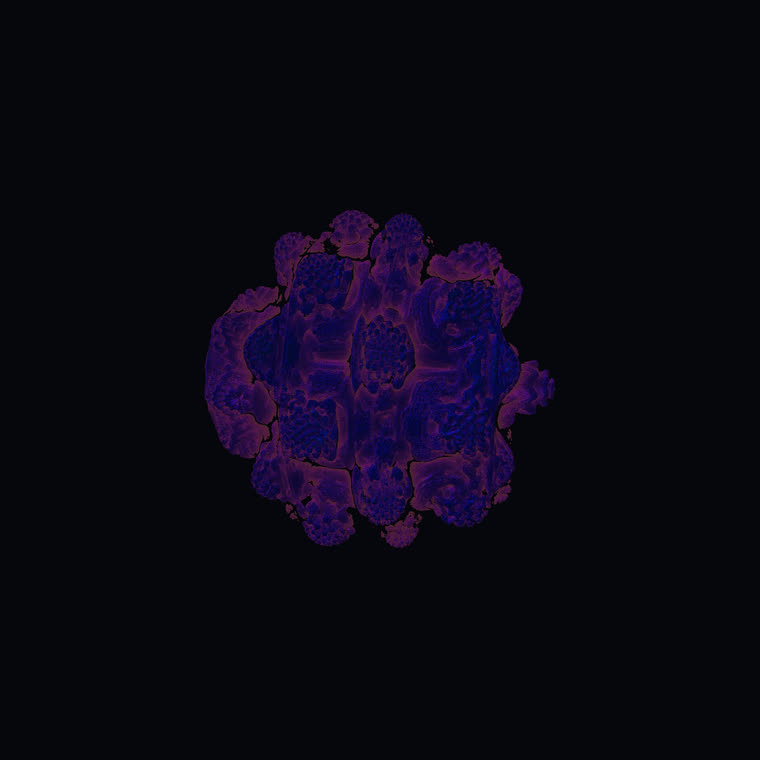
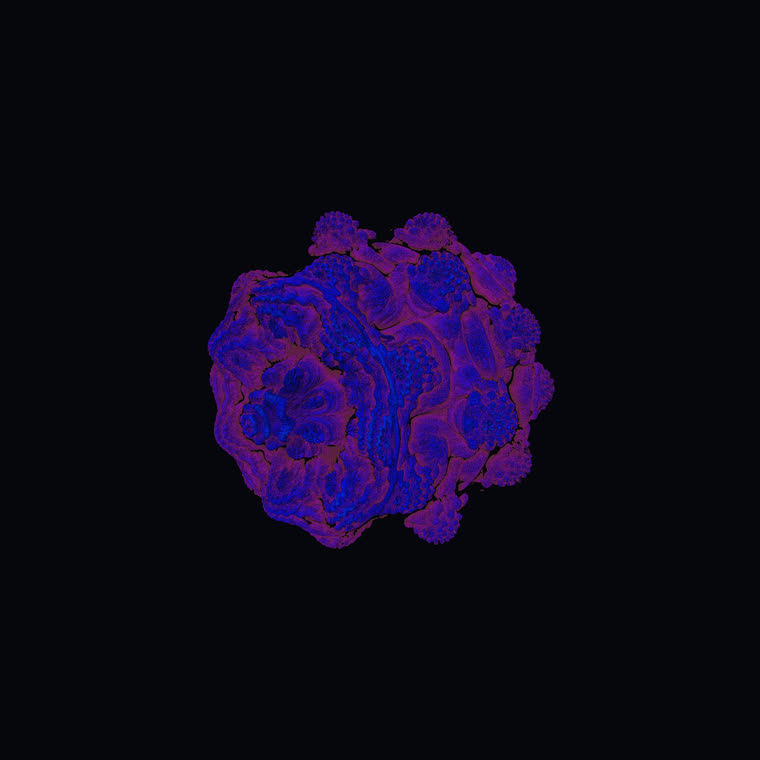
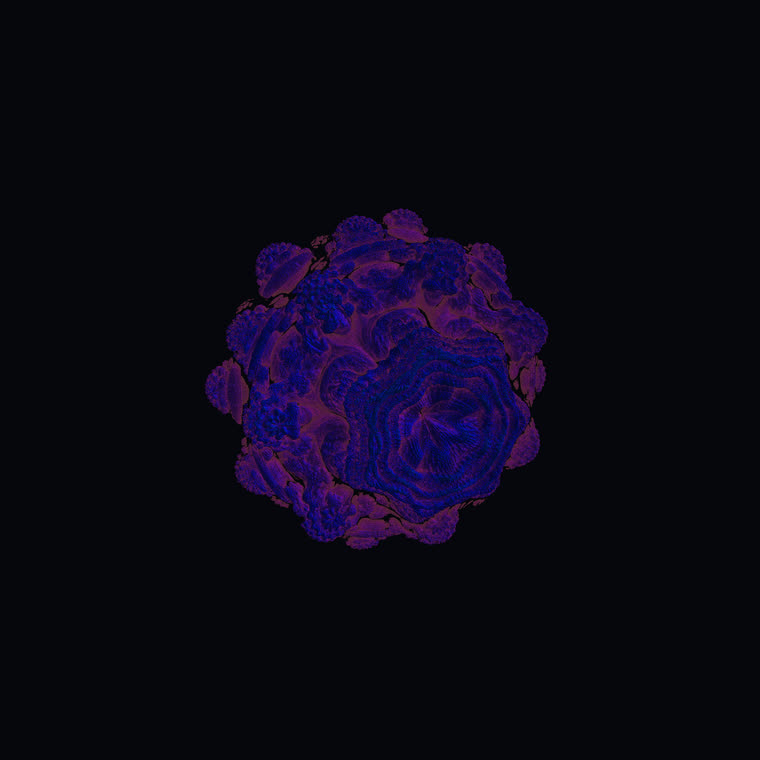
Live turntable captured from Spiralyst Lab.
The hybrid blends the Mandelbulb and the Mandelbox along a single dial, sliding continuously from organic, bulbous skin to faceted, architectural boxes. Stop anywhere in between for chimeras that belong to neither parent.
Half Bulb, Half Box, All Yours
Why choose between organic and architectural when you can dial between them? The Hybrid blends the Mandelbulb's spherical-power fractal with the Mandelbox's fold-and-scale fractal, mixing the two by a single parameter. Turn the knob one way and you get the Mandelbulb's bulbous, cauliflower skin; turn it the other and you get the Mandelbox's nested boxes and corridors; stop in between for chimeras that belong to neither — bulbs sprouting corridors, boxes melting into lobes.
Hybrids like this are how the 3D-fractal community discovered thousands of forms that no single formula could produce. Tools like Mandelbulb3D let artists chain different iteration formulas together, and the space of combinations turned out to be vast and largely unexplored — a genuine frontier mapped mostly by artists rather than mathematicians.
It is the gallery's shapeshifter: one object that morphs across an entire aesthetic spectrum, and the most rewarding type to drive with audio, since the blend can transmute the whole form in time with the music.
Both fractals' distance estimators are evaluated at every sample point — the full Mandelbulb power map and the full Mandelbox fold map.
The two distance estimates are linearly blended by t. t = 0 is a pure Mandelbulb, t = 1 a pure Mandelbox, t = 0.5 an even hybrid.
In Spiralyst Lab
Spiralyst Lab runs both full distance estimators at every step and linearly mixes their outputs by the blend parameter t (default 0.5). One honest note: this blends the two distance fields, not the iterations themselves, so the in-between forms are an inexact hybrid that belongs to neither pure fractal — but as the code's own comment puts it, 'the artifact is part of the charm.' All the usual Mandelbulb (power) and Mandelbox (scale) controls apply to their respective halves; animate t with audio and the whole object transmutes from bulb to box and back.
Every parameter below is a live control — set it by hand, map it to a frequency band, or let it ride a smooth animation. These ranges are the actual in-app slider limits.
| Parameter | Range (in-app) |
|---|---|
| Blend (Bulb↔Box) | 0.0 – 1.0 |
| Bulb power | 2.0 – 16.0 |
| Box scale | -1.5 – 3.0 |
| Bulb bailout | 1.5 – 6.0 |
| Iterations | 4 – 14 |
| Surface ε | 0.0001 – 0.005 |
| Ray steps | 16 – 200 |
Audio-reactive by default: uBlend 0→1 (bulb↔box morph), uPower 2→16. Any control can be mapped to audio or animation.
Plus the universal 3D controls every ray-marched type shares: camera (yaw, pitch, distance, FOV) and lighting (light direction, ambient, fog density, glow falloff).
Watch it in action
assets/video/fractals/27-hybrid-bulbox.mp4
Did you know: Hybrid fractals — chaining or blending different formulas per step — are how artists using tools like Mandelbulb3D found thousands of 3D forms that no single equation could ever produce.