2D fractal
Archimedean
Live turntable captured from Spiralyst Lab.
The Archimedean spiral is the most evenly wound of all spirals: its radius grows in direct proportion to the angle, so every turn sits exactly the same distance from the last. It is the geometry of a coiled rope, a clock's hairspring, and the single continuous groove of a vinyl record.
The Clockwork Coil
The Archimedean spiral is the first spiral most people ever draw — the shape a rope makes when you coil it flat, or the groove pressed into a vinyl record. Archimedes described it around 225 BC in his treatise On Spirals, and its defining quality is mechanical evenness: the radius grows in direct proportion to the angle, so each successive turn sits exactly the same distance from the last.
That constant spacing is what gives the curve its engineered, unaccelerating character. There is no exponential rush outward and no crowding at the center — just steady, linear accumulation. Because the gap between turns never changes, the Archimedean spiral is the geometry of choice for things that must pack a long line into a compact disc without overlap: clock hairsprings, scroll compressors, spiral heat exchangers, and the recording groove of a record, which is one continuous Archimedean arc several hundred meters long.
Mathematically it is the simplest possible spiral — linear in polar form — yet it already contains the two ideas every other spiral plays with: a radius that depends on angle, and a phase that lets you spin the whole figure. Change the spacing constant and the arms breathe apart or draw together; add more turns and the disc fills.
In polar coordinates the radius is a straight-line function of the sweep angle θ. The constant a is the radius at the center; b sets how quickly the arm marches outward.
Because growth is linear in θ, every complete revolution adds exactly the same constant gap between neighbouring arms — the spiral's signature, and the property that makes it 'even'.
The polar-to-Cartesian conversion the renderer applies to place each sampled point on the canvas.
In Spiralyst Lab
Spiralyst Lab samples θ across the chosen number of turns (typically 6–14) and stamps a point or brush at each step, computing r = a + b·θ exactly as written, then colouring along the path. One honest caveat: the figure is auto-fit to the canvas after it is built, so the inner-offset a and absolute size are cosmetic — only the ratio of spacing to start radius (the shape) is visible. In the gallery turntable the whole curve spins (rotation 0→2π).
Every parameter below is a live control — set it by hand, map it to a frequency band, or let it ride a smooth animation. These ranges are the actual in-app slider limits.
| Parameter | Range (in-app) |
|---|---|
| Turns | 2 – 30 |
| Spacing | 0.005 – 0.05 |
Audio-reactive by default: turns 4→20, b 0.008→0.04. Any control can be mapped to audio or animation.
Plus the universal 2D controls every spiral type shares: density & stroke, rotation, squash, jitter, zoom & pan, glow, trails, vignette, and multi-layer stacking (count, hue offset, opacity).
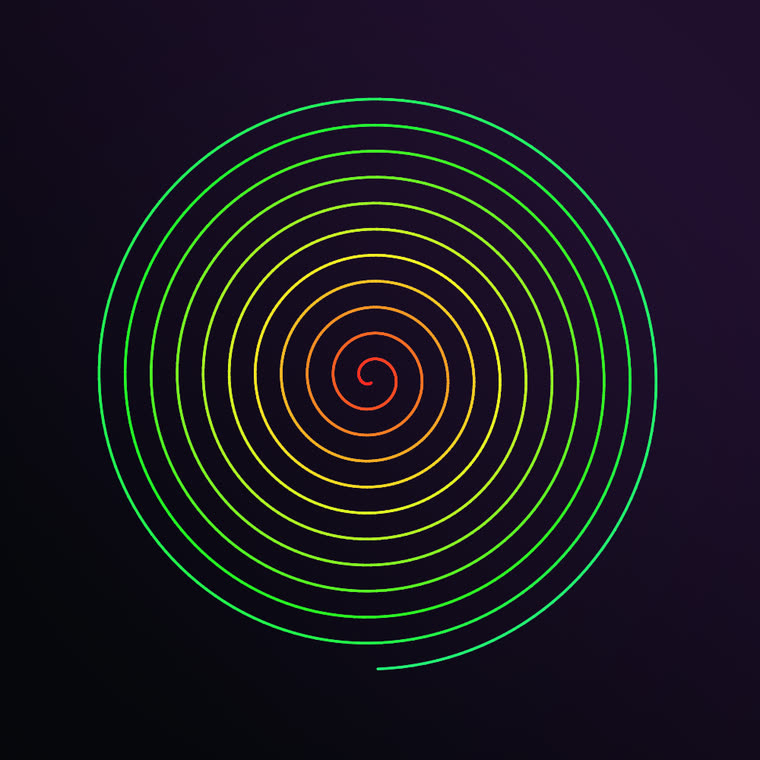
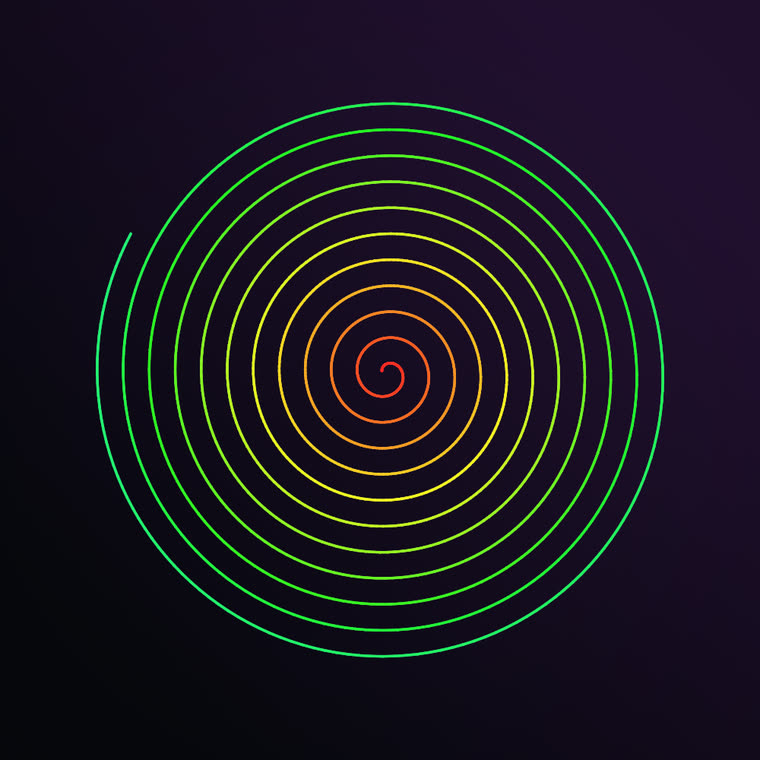
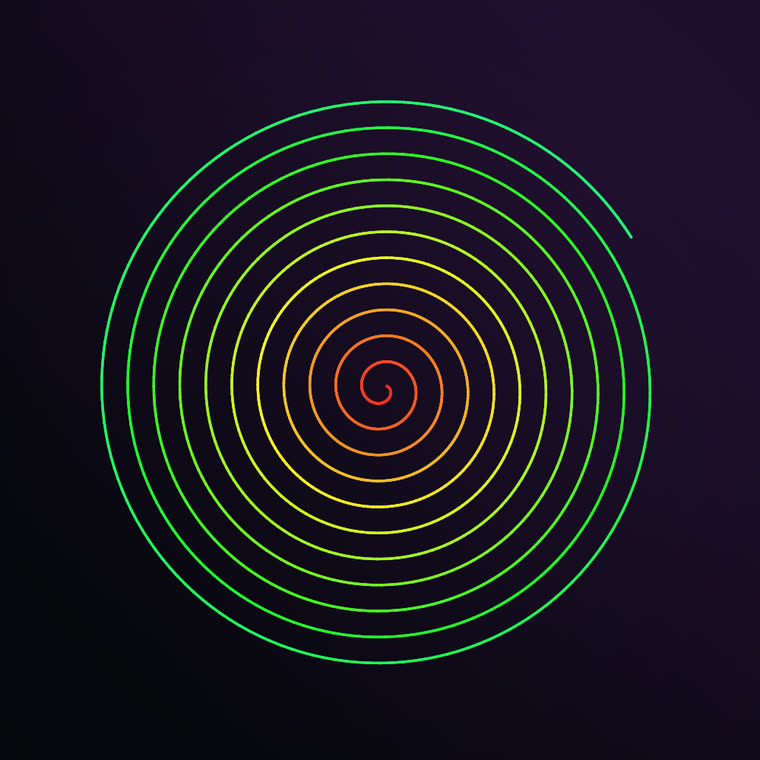
Watch it in action
assets/video/fractals/01-archimedean.mp4
Did you know: Unroll an Archimedean spiral and every loop is the same length apart — which is exactly why a turntable needle can track a single groove for 20 minutes at a constant feed rate.