2D fractal
Logarithmic
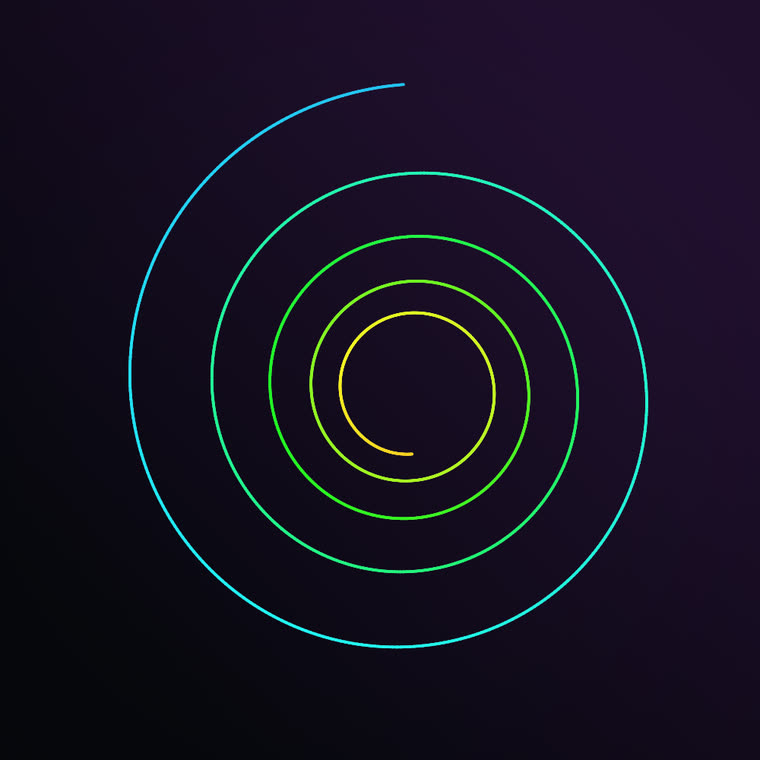
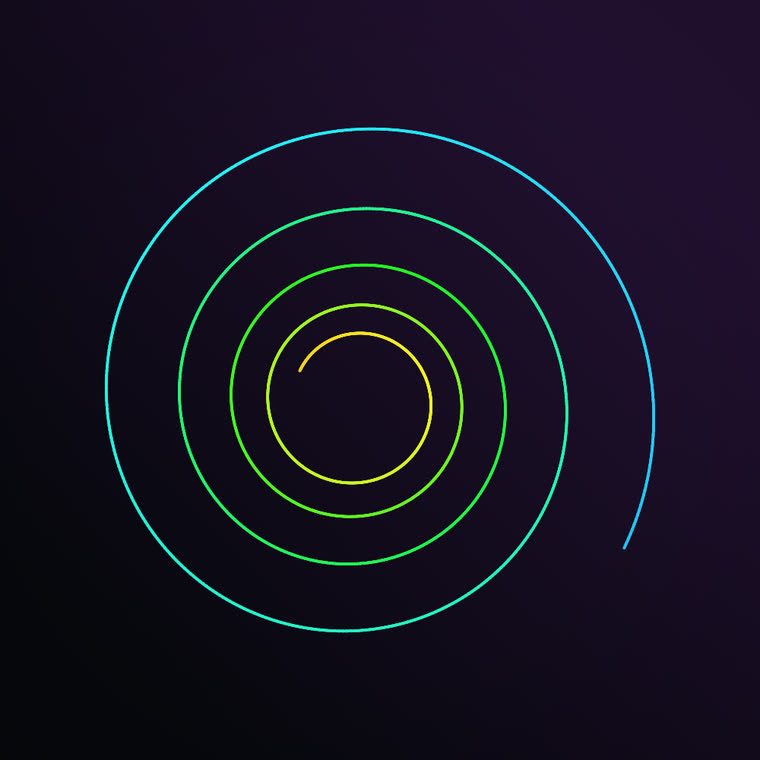
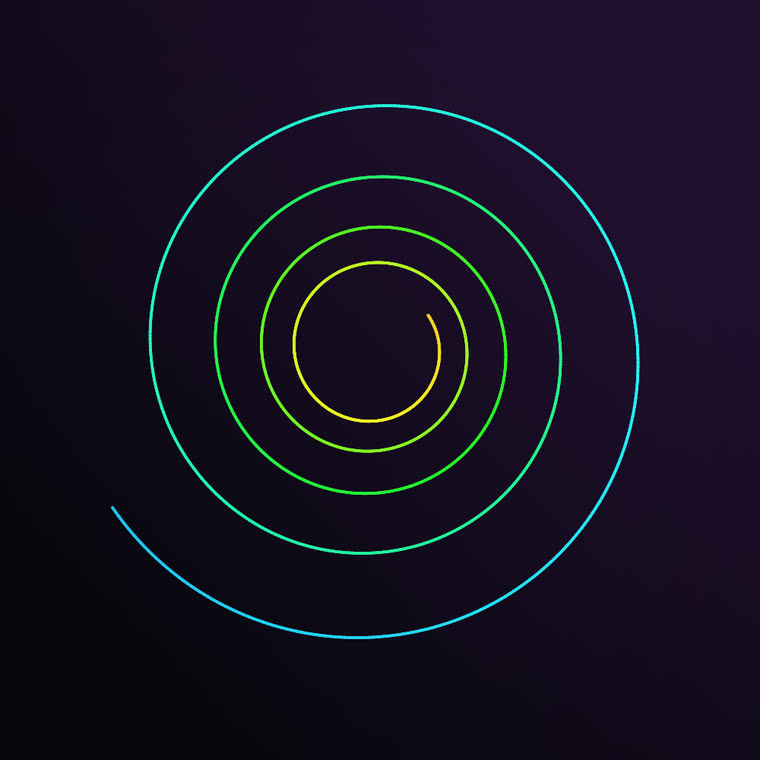
Live turntable captured from Spiralyst Lab.
The logarithmic spiral multiplies its radius by a fixed factor with every turn, which makes it look identical at any zoom — the simplest self-similar shape in nature. It is the curve of nautilus shells, ram's horns, hurricanes, and the arms of spiral galaxies.
The Marvelous Spiral
The logarithmic — or 'equiangular' — spiral trades the Archimedean's constant spacing for constant proportion. Instead of adding the same gap each turn, it multiplies the radius by the same factor each turn. The consequence is profound: zoom in or out and the curve looks exactly the same. It is genuinely self-similar, the simplest fractal hiding in plain sight.
Jacob Bernoulli was so taken with this property that he called it the spira mirabilis, the marvellous spiral, and asked for one on his gravestone with the motto Eadem mutata resurgo — 'though changed, I rise again the same.' (The engraver, not a mathematician, carved an Archimedean spiral instead.) The curve earns its other name, equiangular, from a second remarkable fact: it crosses every ray drawn from its center at the same constant angle, which is precisely why a moth spiralling toward a candle at a fixed bearing traces one.
It is the growth curve of the living world. The chambered nautilus adds shell at a constant proportional rate and so grows along a logarithmic spiral; the same shape appears in ram's horns, the seed spirals of a sunflower, the bands of a hurricane, and the arms of grand-design galaxies. The special case where each turn scales by the golden ratio φ ≈ 1.618 is the famous 'golden spiral'.
The radius grows exponentially with the angle. a scales the whole figure; b is the tightness — small b winds it tight, large b flings the arms open.
The equiangular property: the curve meets every radius from the center at the same constant angle φ. That fixed angle is the source of its self-similarity.
Each full revolution multiplies the radius by this constant factor. When that factor equals the golden ratio, you have the golden spiral.
In Spiralyst Lab
The app evaluates r = a·e^(b·θ) over several turns (a seeded chirality flips clockwise/counter-clockwise) and colours along the arc. As with all the spiral types the result is auto-fit to the canvas, so only the growth rate b — the pitch — is visually meaningful; a washes out. It pairs beautifully with a multi-layer stack and a slow hue animation.
Every parameter below is a live control — set it by hand, map it to a frequency band, or let it ride a smooth animation. These ranges are the actual in-app slider limits.
| Parameter | Range (in-app) |
|---|---|
| Turns | 1 – 10 |
| Growth | 0.05 – 0.4 |
Audio-reactive by default: b 0.06→0.35, rotation. Any control can be mapped to audio or animation.
Plus the universal 2D controls every spiral type shares: density & stroke, rotation, squash, jitter, zoom & pan, glow, trails, vignette, and multi-layer stacking (count, hue offset, opacity).
Watch it in action
assets/video/fractals/02-logarithmic.mp4
Did you know: Because it is self-similar, a logarithmic spiral survives any amount of zoom unchanged — the reason it reads cleanly whether it is two centimetres on a phone or two metres on an LED wall.