2D fractal
Fermat
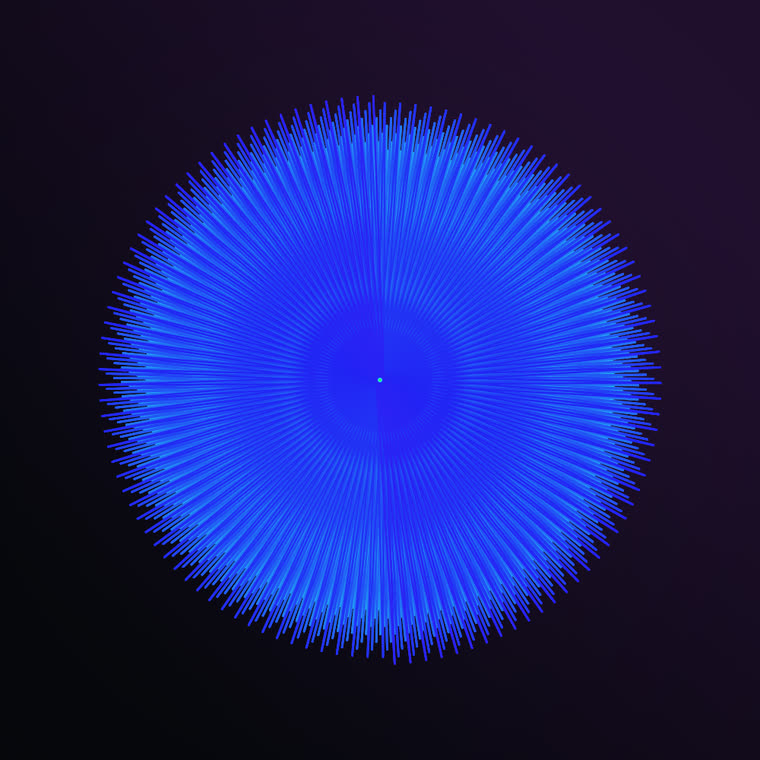
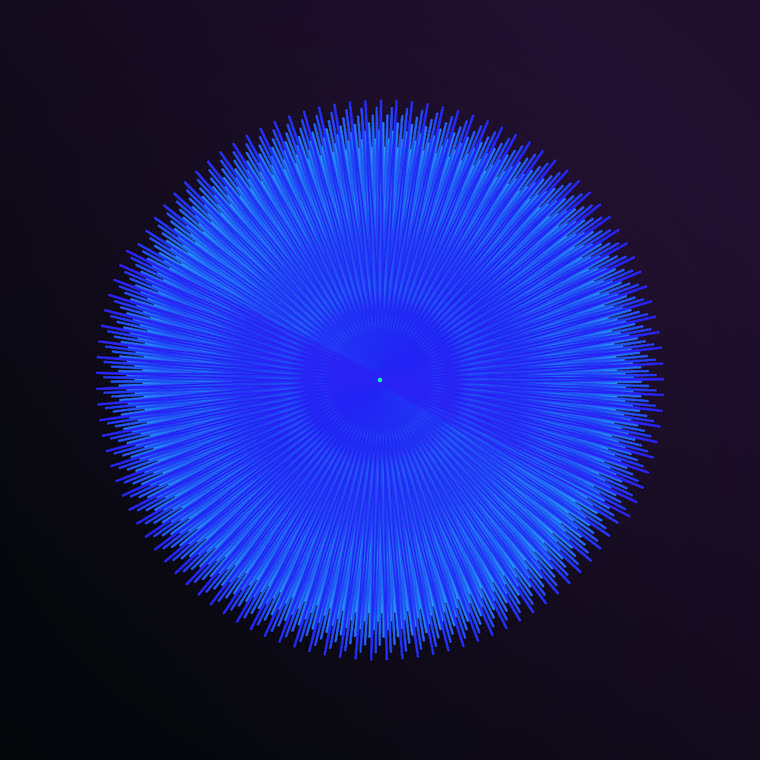
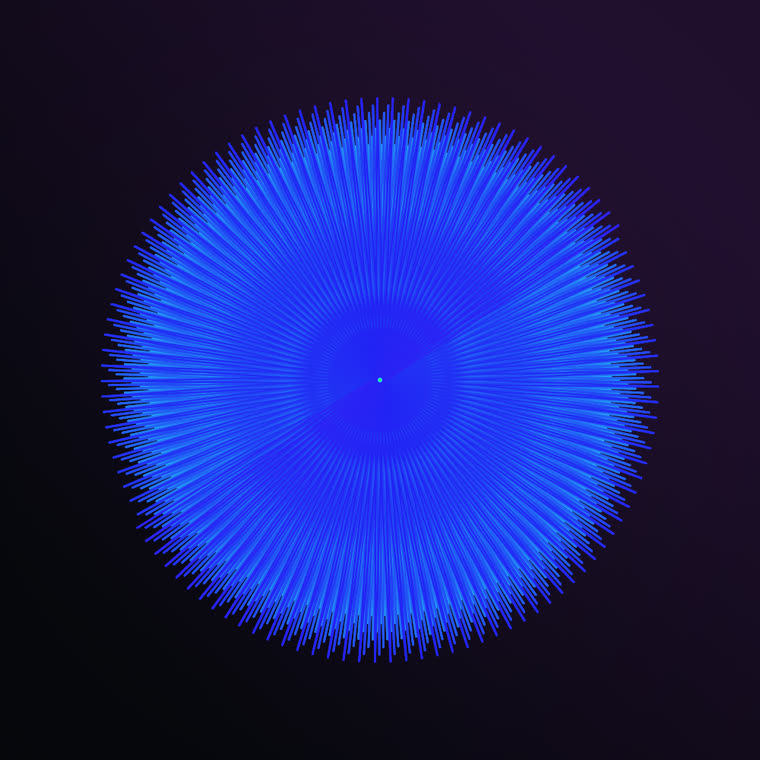
Live turntable captured from Spiralyst Lab.
Fermat's spiral grows with the square root of the angle, so it races outward near the center and then slows, weaving two interleaved arms into a tight, symmetric rosette. Paired with the golden angle, it becomes the classic mathematical model of a sunflower's seed head.
Two Arms, One Seed Head
Fermat's spiral, named for Pierre de Fermat who studied it in 1636, is the quiet, balanced cousin of the Archimedean. Here the radius grows not with the angle but with the square root of the angle, so the curve sweeps outward quickly near the center and then ever more slowly. The true Fermat spiral has two arms — a positive and a negative branch — spiralling out from a shared origin in opposite directions, interleaving into a tight rosette.
The square-root law has an elegant packing consequence: each successive loop encloses roughly the same additional area. That even distribution of area is why Fermat's spiral, combined with the golden angle, forms the mathematical backbone of the 'Vogel model' of a sunflower head — it is the curve along which seeds are laid down so that the seed head fills evenly with no wasted space.
Of all the elementary spirals it is the one that most resembles a packed disc rather than an open coil, which is why it recurs in models of plant growth, in the layout of mirrors in some solar concentrators, and wherever points must tile a circle smoothly.
The ± gives the two symmetric arms spiralling out in opposite directions from one shared center — the textbook twin-armed Fermat spiral.
A direct consequence of the square-root growth: each new loop adds roughly equal area, packing the plane evenly — the reason it models seed heads.
In Spiralyst Lab
Spiralyst Lab's version is deliberately a stylised relative of the pure curve: rather than drawing the +√θ and −√θ branches as two continuous arms, it sweeps r = a·√θ and flips the sign on alternating samples, so consecutive points jump between the two branches and stitch a woven, zig-zag figure across the pole. The square-root growth and twin-branch character are there, but the literal smooth double-arm is traded for a denser woven look — especially striking with trails turned up, where the interleaving smears into a hypnotic disc.
Every parameter below is a live control — set it by hand, map it to a frequency band, or let it ride a smooth animation. These ranges are the actual in-app slider limits.
| Parameter | Range (in-app) |
|---|---|
| Turns | 4 – 40 |
Audio-reactive by default: turns 6→30. Any control can be mapped to audio or animation.
Plus the universal 2D controls every spiral type shares: density & stroke, rotation, squash, jitter, zoom & pan, glow, trails, vignette, and multi-layer stacking (count, hue offset, opacity).
Watch it in action
assets/video/fractals/03-fermat.mp4
Did you know: Fermat's spiral is one half of the 'Vogel model' — pair its √θ growth with the golden angle and a featureless disc snaps into a sunflower head.