2D fractal
Hyperbolic
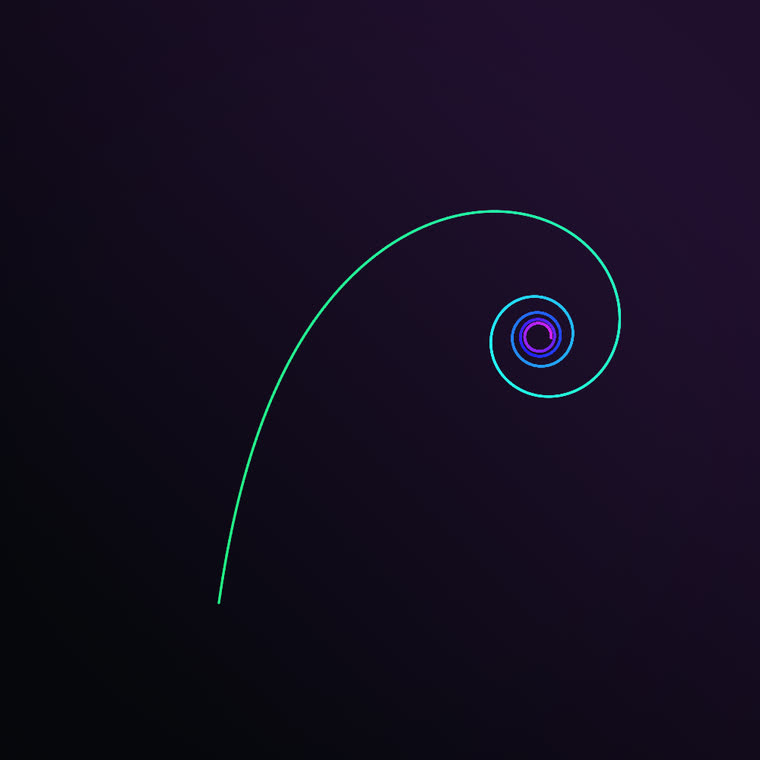
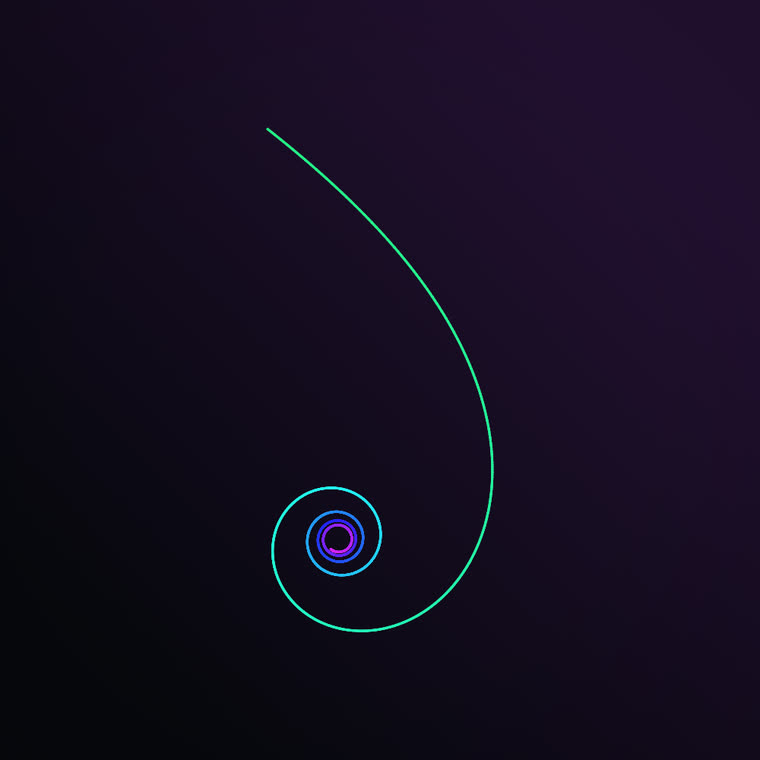
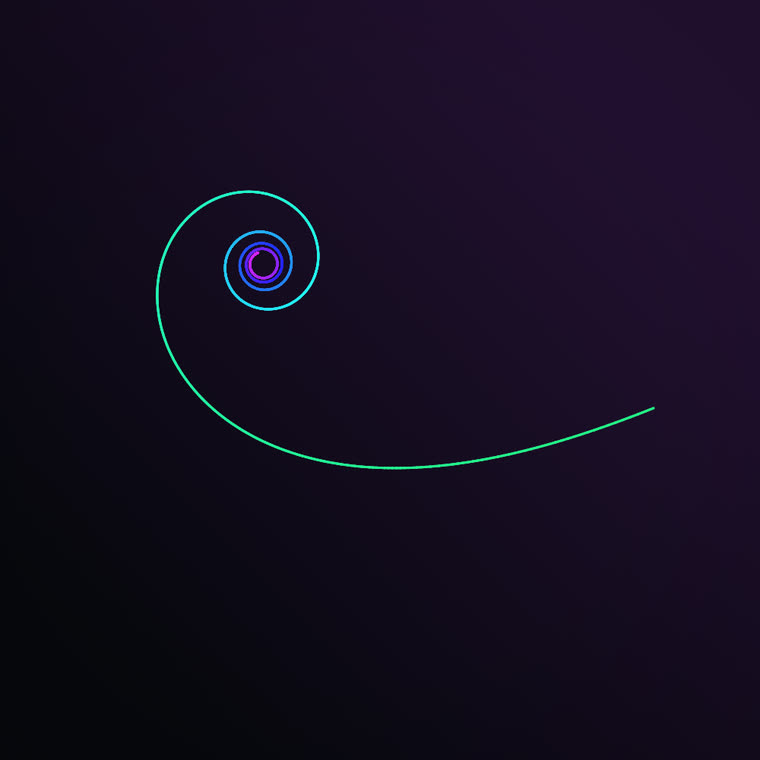
Live turntable captured from Spiralyst Lab.
The hyperbolic spiral is the Archimedean turned inside-out: its radius is inversely proportional to the angle, so it rushes in from infinity, winds ever tighter, and approaches a central pole it can never quite reach. It reads as dense and frantic at the rim and vanishes toward the core.
The Spiral Turned Inside-Out
The hyperbolic spiral, also called the reciprocal spiral, is what you get when the radius is inversely proportional to the angle rather than directly proportional to it. Pierre Varignon studied it in 1704. The behaviour is dramatic at both ends: as the angle approaches zero the radius blows up toward infinity, and as the angle grows without bound the radius shrinks toward a central pole it can never actually reach.
This gives the curve a strange double character. Far out, it flattens and hugs a horizontal asymptote — it approaches a straight line rather than closing off. Close in, it winds tighter and tighter forever around a center that remains forever out of reach. Visually it reads as dense and frantic at the rim, thinning to nothing toward the core.
Physically, the hyperbolic spiral is the path you would walk if you tried to circle a fixed point at a constant angular speed while also moving at a constant linear speed — a feat that becomes impossible as you near the center, which is exactly why the pole is unreachable.
The radius is the reciprocal of the angle. As θ → ∞ the radius → 0 (the unreachable pole); as θ → 0 the radius → ∞.
Far from the center the spiral approaches a horizontal asymptote at height a — it straightens into a line instead of curling shut.
In Spiralyst Lab
Because the curve runs to infinity at θ = 0, Spiralyst Lab starts the sweep at a small positive angle and ends at a chosen 'reach', keeping the runaway tail on-canvas; the 'pull' parameter is the constant a. The density gradient — crowded at the rim, sparse toward the core — makes it a wonderful base for high-glow, high-trail looks, since the bloom has somewhere to concentrate.
Every parameter below is a live control — set it by hand, map it to a frequency band, or let it ride a smooth animation. These ranges are the actual in-app slider limits.
| Parameter | Range (in-app) |
|---|---|
| Reach | 5 – 80 |
| Pull | 0.2 – 1.5 |
Audio-reactive by default: thetaMax 8→60, a 0.2→1.5. Any control can be mapped to audio or animation.
Plus the universal 2D controls every spiral type shares: density & stroke, rotation, squash, jitter, zoom & pan, glow, trails, vignette, and multi-layer stacking (count, hue offset, opacity).
Watch it in action
assets/video/fractals/04-hyperbolic.mp4
Did you know: The asymptotic line the hyperbolic spiral approaches is real but never touched — the curve gets arbitrarily close to it and keeps going forever.