2D fractal
Phyllotaxis
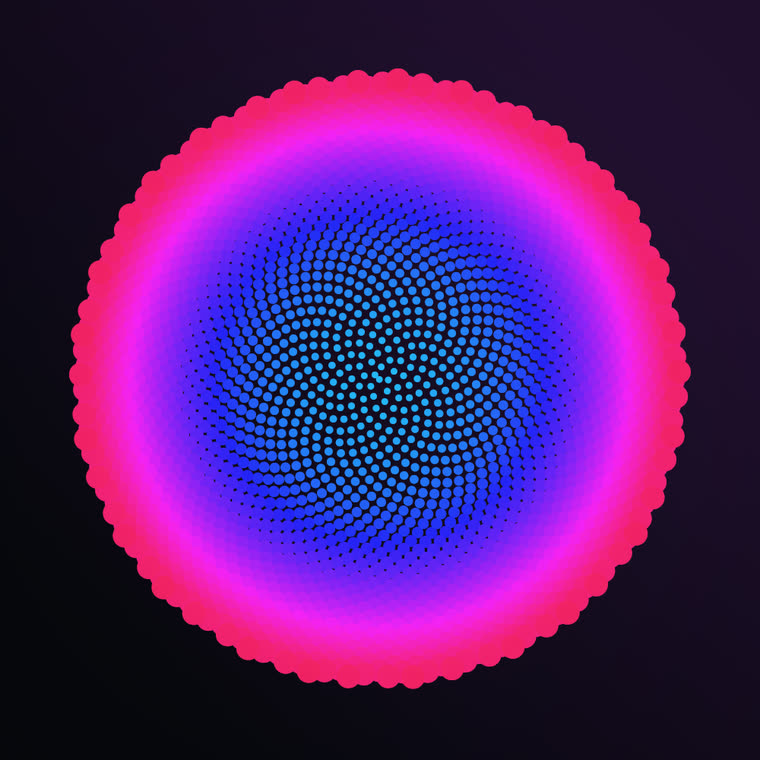
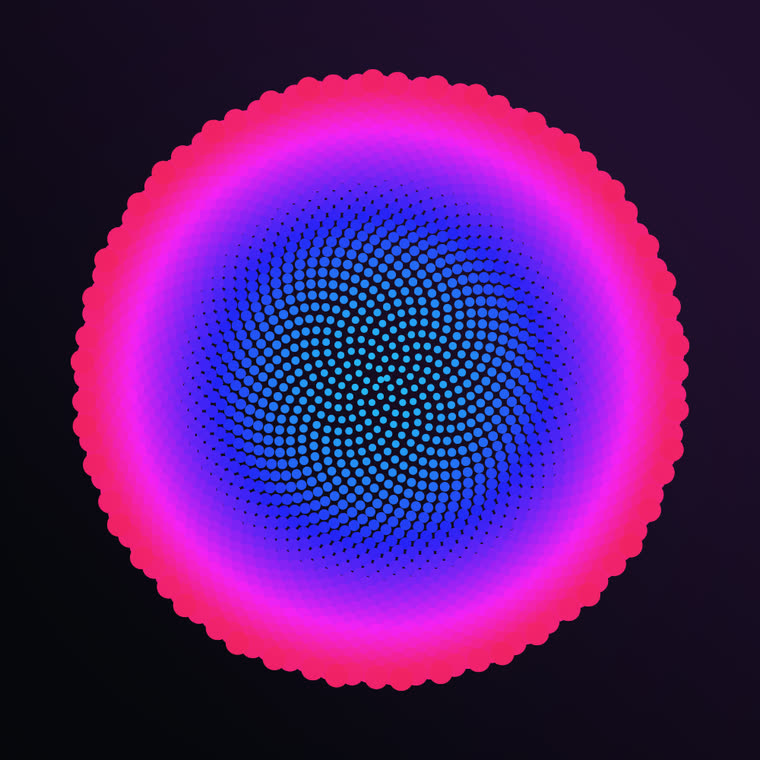
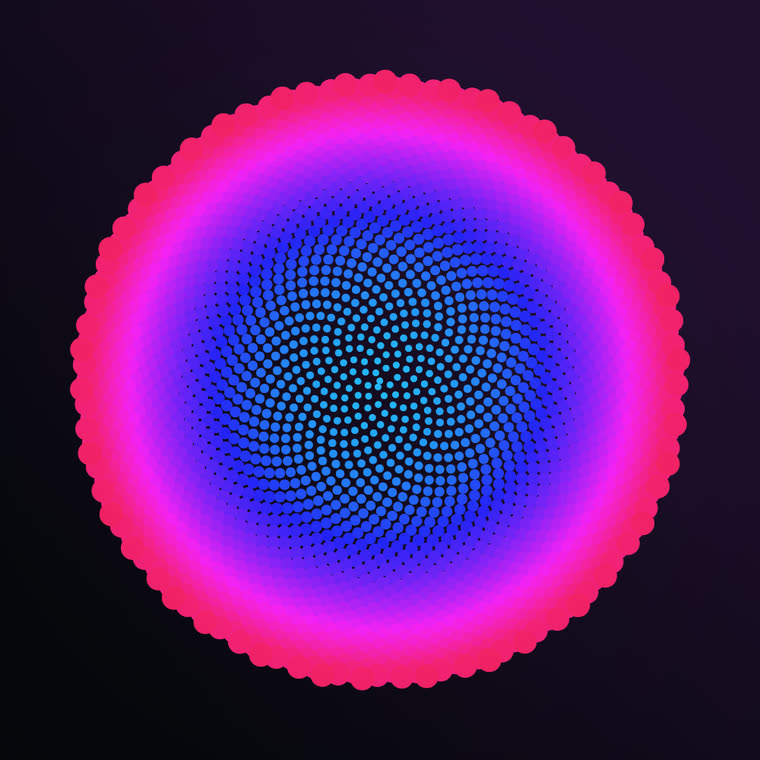
Live turntable captured from Spiralyst Lab.
Phyllotaxis is the pattern plants use to pack seeds and florets, placing each new point one golden angle — about 137.5° — from the last so a disc fills with no gaps and no seams. The familiar crossing spirals of a sunflower head emerge from this single rule, and their counts are almost always consecutive Fibonacci numbers.
The Sunflower's Secret Angle
Phyllotaxis is the mathematics of how plants arrange repeated parts — seeds in a sunflower, scales on a pinecone, florets in a daisy, leaves around a stem. The astonishing discovery, formalised by H. Vogel in 1979, is that a single rule reproduces it: place each new element one fixed turn from the previous one, let that turn be the 'golden angle', and space the elements outward by the square root of their count. The result packs a disc perfectly evenly, with no gaps and no preferred direction.
The golden angle is what you get by dividing a full turn in the golden ratio — roughly 137.5°. It is special because the golden ratio is, in a precise sense, the 'most irrational' number: it is the hardest of all numbers to approximate with simple fractions. That irrationality means successive points never line up into spokes, so they fill the gaps between earlier points instead of stacking on top of them. Nudge the angle even a fraction of a degree away from 137.5° and the packing visibly fails — the seed head 'clicks' into coarse spiral arms.
Those spiral arms — the parastichies you see crossing a sunflower head — are not placed deliberately; they emerge for free from the single golden-angle rule, and their counts are almost always consecutive Fibonacci numbers (34 one way, 55 the other), because the Fibonacci sequence is the rational ladder that climbs toward the golden ratio.
The golden angle, where φ = (1+√5)/2 is the golden ratio. Each successive point is rotated by this same irrational fraction of a turn, so no two ever align.
Vogel's model: the n-th point sits at angle n·ψ and radius proportional to √n, which spreads all points to occupy equal area — even, edge-to-edge packing.
The golden ratio. Because it is the worst-approximable number, the golden angle is the worst possible angle for points to ever repeat — which is exactly why the packing has no gaps.
In Spiralyst Lab
Spiralyst Lab computes the golden angle directly as π(3 − √5) and lays down hundreds of brush stamps by index n, dot radius ramping outward so the head reads as a real seed disc. A small 'angle drift' control detunes off 137.5° on purpose — drive it with audio and the seed head pulses between smooth packing and visible spiral arms in time with the music.
Every parameter below is a live control — set it by hand, map it to a frequency band, or let it ride a smooth animation. These ranges are the actual in-app slider limits.
| Parameter | Range (in-app) |
|---|---|
| Angle drift | -0.012 – 0.012 |
Audio-reactive by default: drift -0.01→0.01, glow. Any control can be mapped to audio or animation.
Plus the universal 2D controls every spiral type shares: density & stroke, rotation, squash, jitter, zoom & pan, glow, trails, vignette, and multi-layer stacking (count, hue offset, opacity).
Watch it in action
Did you know: Count the spirals in a real sunflower and you will almost always get Fibonacci numbers. The plant isn't counting — the golden angle does the arithmetic automatically.