
2D fractal
Rose (coiled)
Live turntable captured from Spiralyst Lab.
This rose winds a flower's petals onto a steadily growing radius, so instead of closing into a fixed bloom it spirals outward in layered, blooming arcs. A single integer — the petal count — sets how many lobes ring each turn, from a simple flower to a dense starburst.
A Flower Set Spinning
A rose curve is the shape traced when the radius oscillates as you sweep around the center: petals bloom out and fold back in. The classic rose, the rhodonea studied by Guido Grandi around 1720, closes on itself into a fixed flower of petals. This 'coiled' rose takes that petal oscillation and rides it on a steadily growing radius, so instead of closing, the petals are carried outward and the flower spirals open into a layered bloom.
It is the most overtly floral of the spiral family — ornamental, symmetric, and endlessly variable from a single integer: the petal count. A small count gives a clean few-lobed flower; a large count gives a dense starburst. Because the petal oscillation here is kept strictly positive (it swells and shrinks but never crosses through zero), every value of the count produces exactly that many bulges per turn, with none of the petal-doubling parity quirk of the pure mathematical rose.
The effect is a spiral that breathes radially as it winds — a bloom that opens outward, ideal for layering and for animating against a beat.
The pure rhodonea, for reference: k petals when k is odd, 2k petals when k is even — the textbook parity rule.
A linearly growing radius (growth·θ) — the 'coil' that makes it spiral outward — multiplied by a petal envelope that oscillates between 0.2 and 1.0 and never goes negative, so you get exactly k bulges per turn regardless of parity.
In Spiralyst Lab
Spiralyst Lab draws the coiled form above rather than the pure rhodonea: the petal count k is the headline control, the radius grows linearly with θ across the chosen turns, and the always-positive envelope means the petals are amplitude bulges on an outward coil, not separate closed loops. Spin it, layer it, and animate the petal count or hue against the beat for a blooming, pulsing flower. (The recursive Fractal-Rose type uses the pure r = cos(kθ) curve instead.)
Every parameter below is a live control — set it by hand, map it to a frequency band, or let it ride a smooth animation. These ranges are the actual in-app slider limits.
| Parameter | Range (in-app) |
|---|---|
| Petals (k) | 2 – 12 |
| Turns | 4 – 30 |
| Growth | 0.003 – 0.03 |
Audio-reactive by default: k 2→9 (petal morph), growth 0.003→0.03. Any control can be mapped to audio or animation.
Plus the universal 2D controls every spiral type shares: density & stroke, rotation, squash, jitter, zoom & pan, glow, trails, vignette, and multi-layer stacking (count, hue offset, opacity).
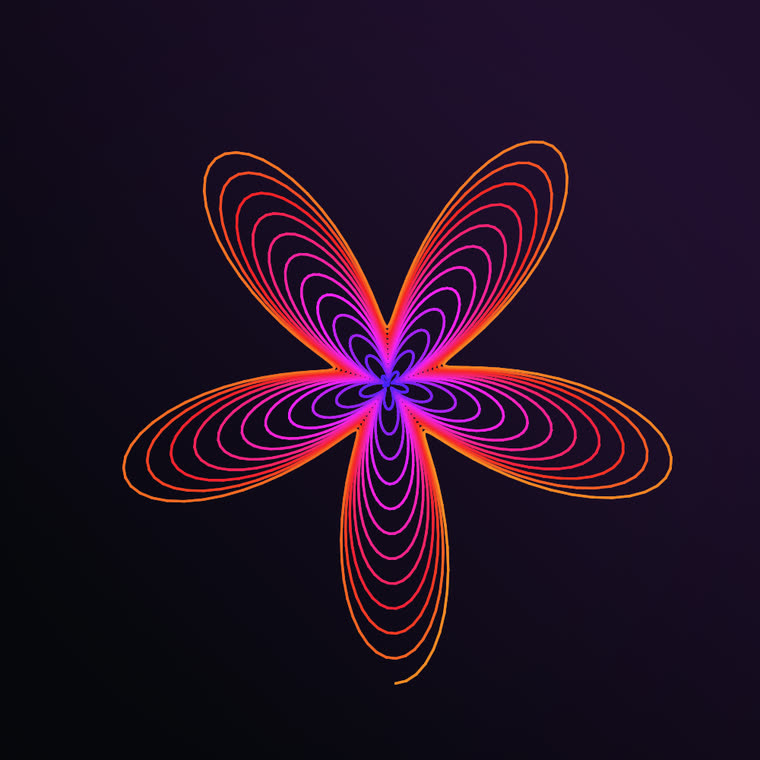
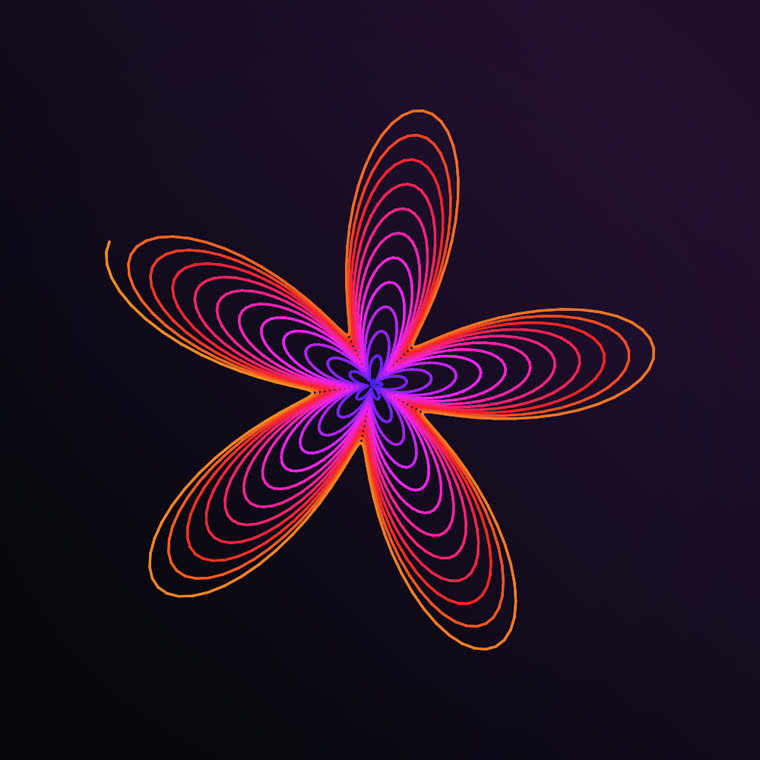
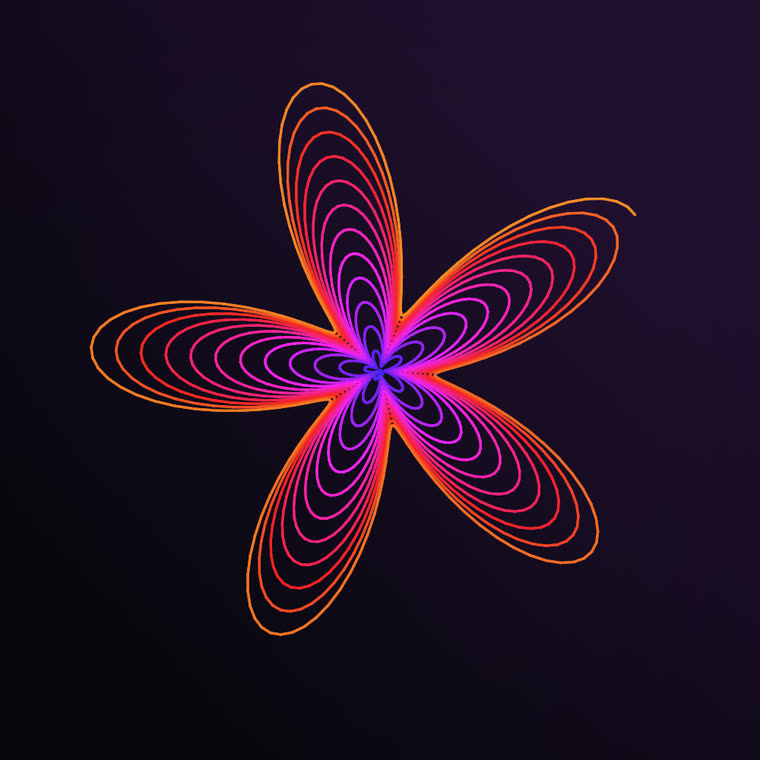
Watch it in action
assets/video/fractals/06-rose.mp4
Did you know: Rose curves were named rhodonea — 'little roses' — by Guido Grandi in the 1720s, who was charmed that such simple trigonometry produced flowers.