3D fractal
TPMS Gyroid
Live turntable captured from Spiralyst Lab.
The gyroid is a minimal surface with no straight lines and no mirror symmetry, weaving through space as a single continuous channel that never crosses itself. It appears in 3D-printing infill, photonic materials, and the structural color of butterfly wings.
The Surface With No Straight Lines
The gyroid is the rock star of minimal surfaces. Discovered by NASA physicist Alan Schoen in 1970, it is a triply-periodic minimal surface with a remarkable twist: it contains no straight lines at all, and it has no mirror symmetry — it is chiral, meaning it comes in left- and right-handed forms that cannot be superimposed. It weaves through space as a single continuous channel that never self-intersects.
Like the Schwarz surface it is defined by one short equation, but the gyroid's three rotated sine-cosine terms are what remove every straight line and give it its handedness. The result is an endlessly flowing, labyrinthine membrane — the kind of structure you can fall into visually because it offers no flat surface for the eye to rest on.
It has become a genuine design icon. Gyroid lattices show up in 3D-printing infill (maximum stiffness for minimum material), in photonic metamaterials, in high-surface-area battery and filtration structures, in running-shoe midsoles — and, most beautifully, in nature: the iridescent blues and greens of certain butterfly and beetle scales come from gyroid-structured chitin that bends light, structural colour with no pigment at all.
The gyroid's implicit equation — three rotated sine-cosine terms. That rotation is what eliminates the straight lines and gives the surface its chiral weave.
Unlike the Schwarz P surface, the gyroid cannot be superimposed on its mirror image — it has a definite left- or right-handedness.
In Spiralyst Lab
Spiralyst Lab ray-marches the gyroid from its implicit equation, coordinates scaled by a frequency control and the membrane given a finite thickness so it renders as a solid shell. The continuous, non-intersecting channel makes for endless flow-through shots as the camera orbits; adjust the thickness to fatten or thin the weave.
Every parameter below is a live control — set it by hand, map it to a frequency band, or let it ride a smooth animation. These ranges are the actual in-app slider limits.
| Parameter | Range (in-app) |
|---|---|
| Frequency | 0.5 – 5.0 |
| Thickness | 0.01 – 0.7 |
| Surface ε | 0.0001 – 0.005 |
| Ray steps | 16 – 200 |
Audio-reactive by default: uFreq 0.8→4.5, uThick 0.02→0.6. Any control can be mapped to audio or animation.
Plus the universal 3D controls every ray-marched type shares: camera (yaw, pitch, distance, FOV) and lighting (light direction, ambient, fog density, glow falloff).
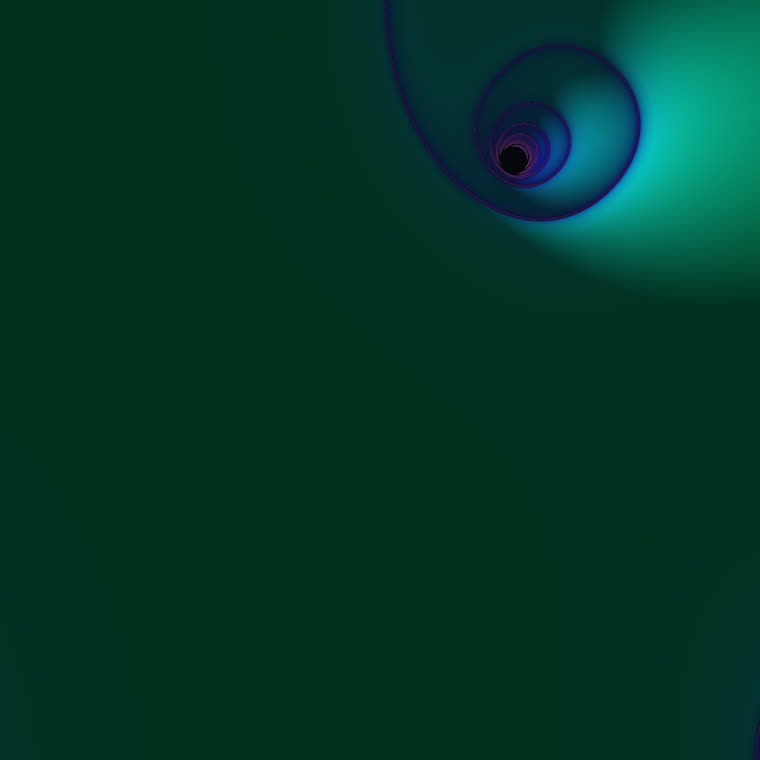
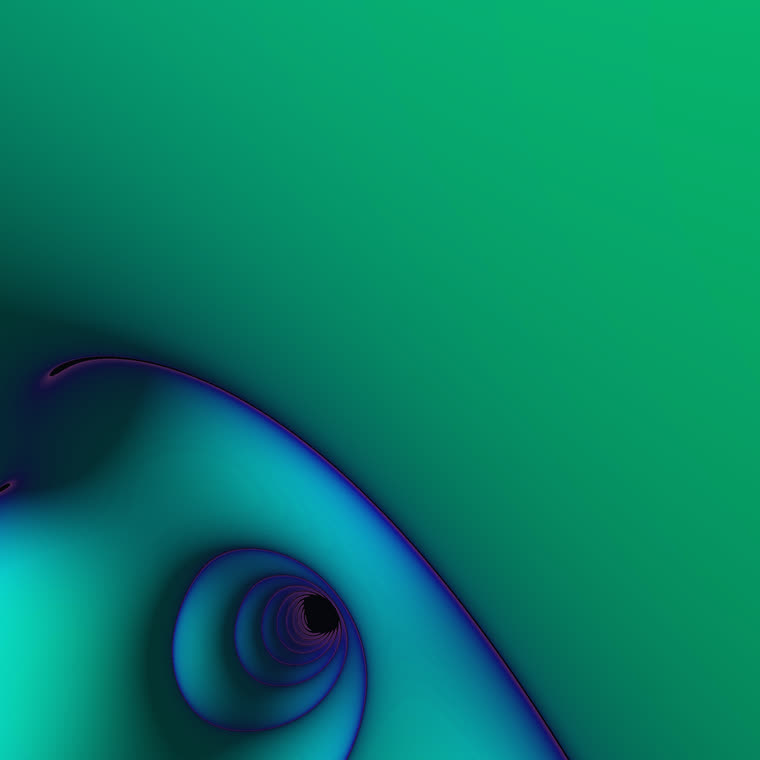
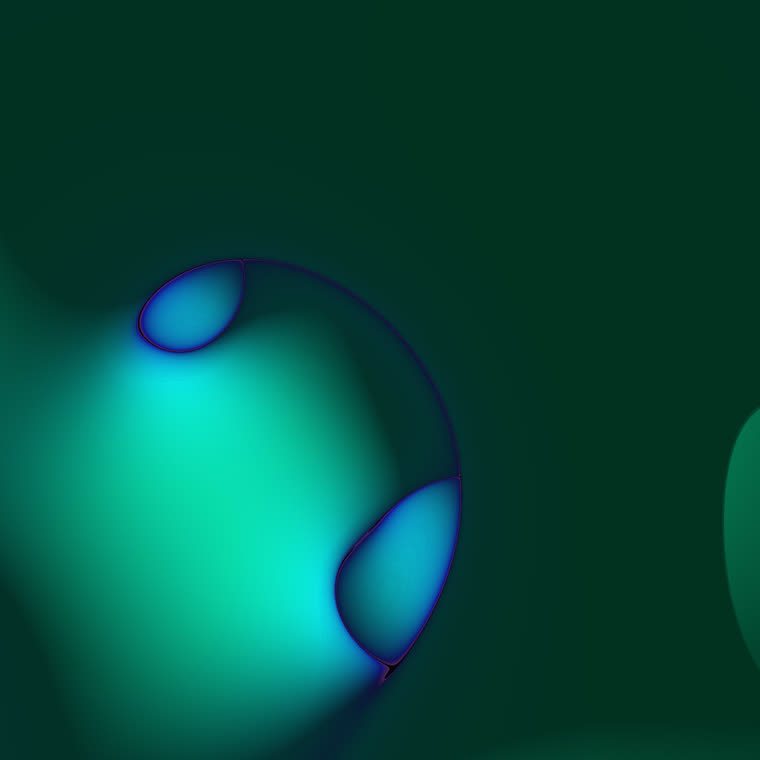
Watch it in action
assets/video/fractals/26-tpms-gyroid.mp4
Did you know: Butterflies and weevils grow gyroid photonic crystals in their wing and shell scales — the impossible metallic blues and greens you see are the gyroid's geometry bending light, not any pigment.