3D fractal
Sierpinski tetrahedron
Live turntable captured from Spiralyst Lab.
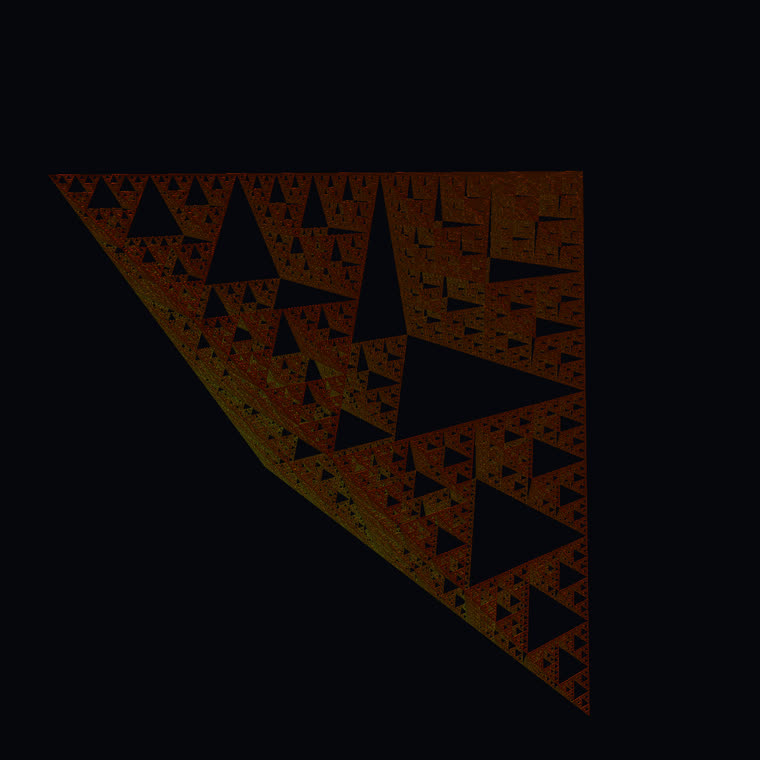
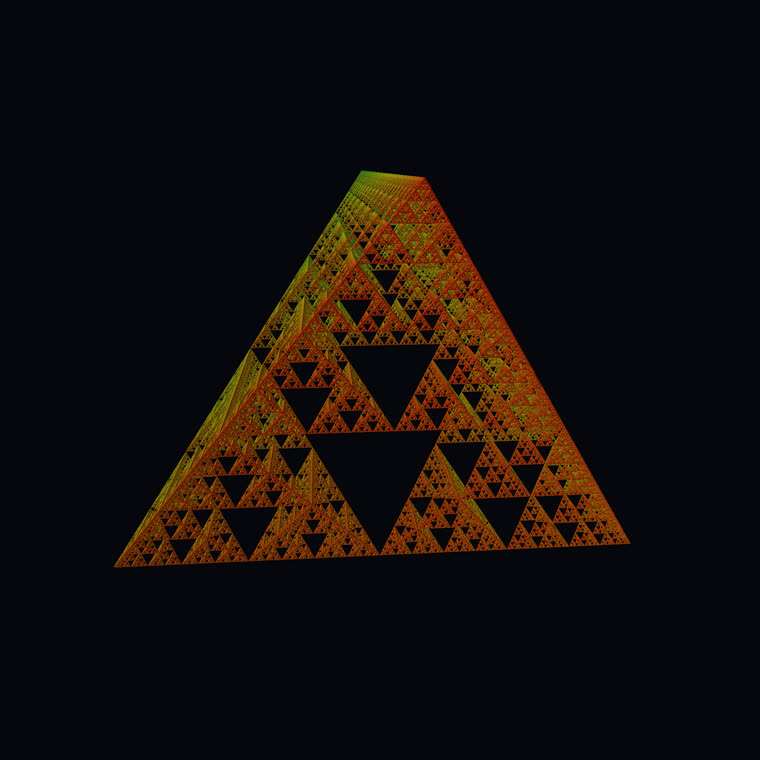
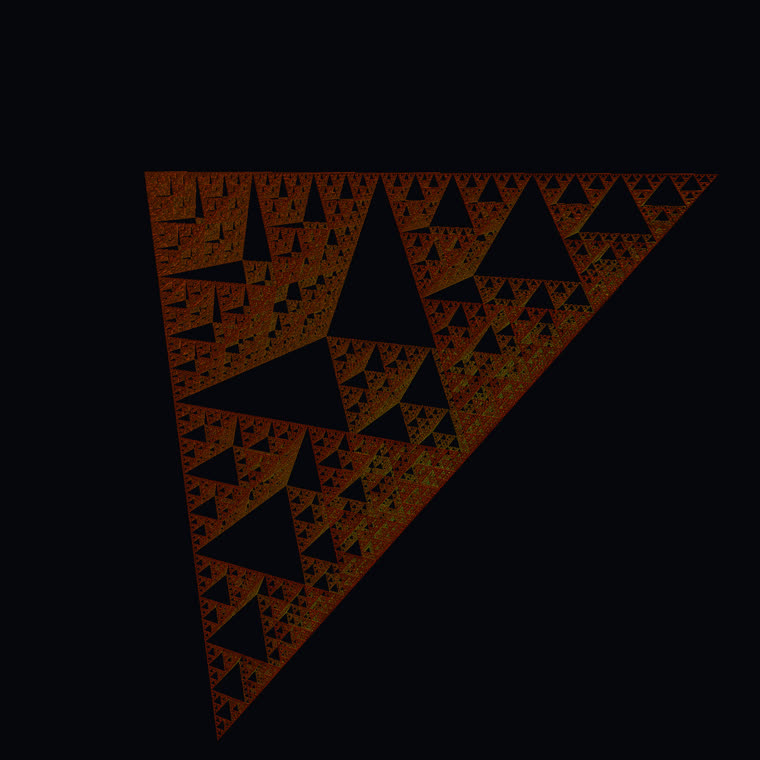
The Sierpinski tetrahedron is the three-dimensional Sierpinski gasket: a tetrahedron endlessly subdivided into four corner copies with the middle thrown away. Its volume melts to nothing while it stays perfectly connected — a skeleton of fractal dimension exactly two.
A Skeleton of Dimension Two
The Sierpiński tetrahedron, or 'tetrix', is the three-dimensional version of the Sierpiński triangle that Wacław Sierpiński described in 1915. Take a regular tetrahedron, shrink it by half toward each of its four corners to make four copies, throw away the empty middle, and repeat on each copy forever. The volume melts away to nothing while the structure stays perfectly connected — a skeletal 3D gasket.
It has a curious dimension: exactly 2. Four copies, each scaled by one half, gives a fractal dimension of log 4 / log 2 = 2 — a surface's worth of complexity bent through three-dimensional space. One consequence is that its shadow, projected onto a plane, can completely fill a solid triangle with no holes, even though the object itself is almost entirely empty.
It is the cleanest possible recursion in three dimensions — four corners, half scale, forever — and reads as an airy, crystalline scaffold, especially as a silhouette against fog.
The iterated function system: four contraction maps, one toward each tetrahedron corner, repeated to the chosen depth.
Exactly two — four pieces, halved each time. A surface's complexity living in 3D space.
The renderer uses the equivalent folding distance estimate — three plane reflections then a contracting affine step — rather than literal copies, so depth is cheap.
In Spiralyst Lab
Spiralyst Lab ray-marches the folding form: three reflections across the planes x+y=0, x+z=0, y+z=0 (the tetrahedral mirrors), then the classical contraction z → scale·z − offset·(scale−1), with a bounding-sphere distance estimate. With the default scale 2 and offset (1,1,1) it is the exact Sierpiński tetrahedron; an optional 'twist' shears the levels into a spiral staircase (random scenes lean on a little twist, so a freshly generated one is gently spiralled rather than pure).
Every parameter below is a live control — set it by hand, map it to a frequency band, or let it ride a smooth animation. These ranges are the actual in-app slider limits.
| Parameter | Range (in-app) |
|---|---|
| Scale | 1.2 – 3.5 |
| Offset X | 0.0 – 2.0 |
| Offset Y | 0.0 – 2.0 |
| Offset Z | 0.0 – 2.0 |
| Twist | -3.14 – 3.14 |
| Iterations | 4 – 24 |
| Surface ε | 0.0001 – 0.005 |
| Ray steps | 16 – 200 |
Audio-reactive by default: uTwist -3→3, uScale 1.2→3.5. Any control can be mapped to audio or animation.
Plus the universal 3D controls every ray-marched type shares: camera (yaw, pitch, distance, FOV) and lighting (light direction, ambient, fog density, glow falloff).
Watch it in action
assets/video/fractals/23-sierpinski-tet.mp4
Did you know: Because its dimension is exactly 2, the Sierpiński tetrahedron can cast a completely solid triangular shadow — a nearly empty object that blocks all the light from one direction.