3D fractal
Pseudo-Kleinian
Live turntable captured from Spiralyst Lab.
The pseudo-Kleinian fractal evokes the infinitely reflected limit sets of Kleinian groups while staying cheap enough to fly through in real time. It is sparse and web-like, spreading organic strands across space like coral, neural tissue, or the cosmic web of galaxies.
The Web Across Space
Kleinian groups, named for Felix Klein, generate some of the most intricate objects in mathematics: limit sets built by applying a set of Möbius transformations over and over, the subject of the famous book Indra's Pearls. A true Kleinian limit set is expensive to compute, so the 'pseudo-Kleinian' is a fast distance-field impostor that captures the look — sparse, spread-out organic webbing strung across space like coral, neural tissue, or the cosmic web of galaxies.
It is built, like the Mandelbox, from folds: an anisotropic box fold (the box is slightly taller in one direction, which gives the form its characteristic non-cubic silhouette) alternating with a spherical inversion that throws points outward through a sphere — the three-dimensional echo of the Möbius maps that generate real Kleinian sets. The result is the most open and exploratory of the 3D fractals: less a solid object, more a structure you drift through.
It is a reminder that much of 3D fractal art is impressionistic — these 'pseudo' forms are chosen because they evoke a rigorous mathematical object while remaining cheap enough to fly through in real time.
An anisotropic box fold — slightly taller in z — which gives the pseudo-Kleinian its distinctive non-cubic silhouette.
A single-branch spherical inversion that throws inner points outward — the 3D stand-in for the Möbius transformations of a true Kleinian group.
In Spiralyst Lab
Spiralyst Lab implements Knighty and Syntopia's pseudo-Kleinian faithfully: the anisotropic (1, 1, 1.3) box fold, the single-max sphere fold whose inner radius you control, and a 'tube-and-cap' distance estimate divided by the accumulated scale. The fold and inversion parameters control how sparse or tangled the web becomes; orbit it with fog so the far strands recede and the depth reads.
Every parameter below is a live control — set it by hand, map it to a frequency band, or let it ride a smooth animation. These ranges are the actual in-app slider limits.
| Parameter | Range (in-app) |
|---|---|
| Scale | 0.5 – 2.5 |
| Sphere fold | 0.02 – 0.8 |
| Iterations | 4 – 16 |
| Surface ε | 0.0001 – 0.005 |
| Ray steps | 16 – 200 |
Audio-reactive by default: uScale 0.8→2.0, uSphereScale 0.05→0.6. Any control can be mapped to audio or animation.
Plus the universal 3D controls every ray-marched type shares: camera (yaw, pitch, distance, FOV) and lighting (light direction, ambient, fog density, glow falloff).
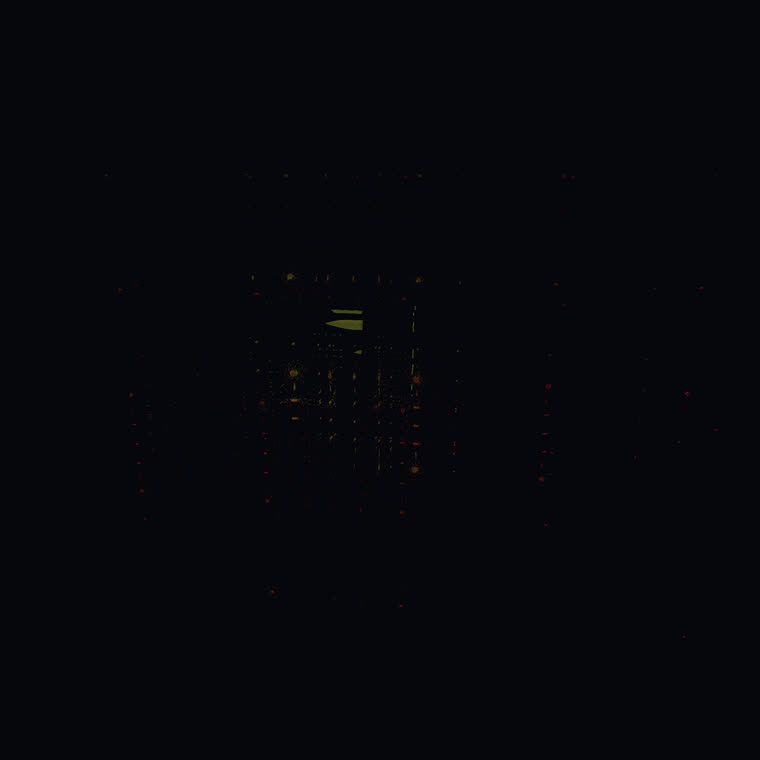
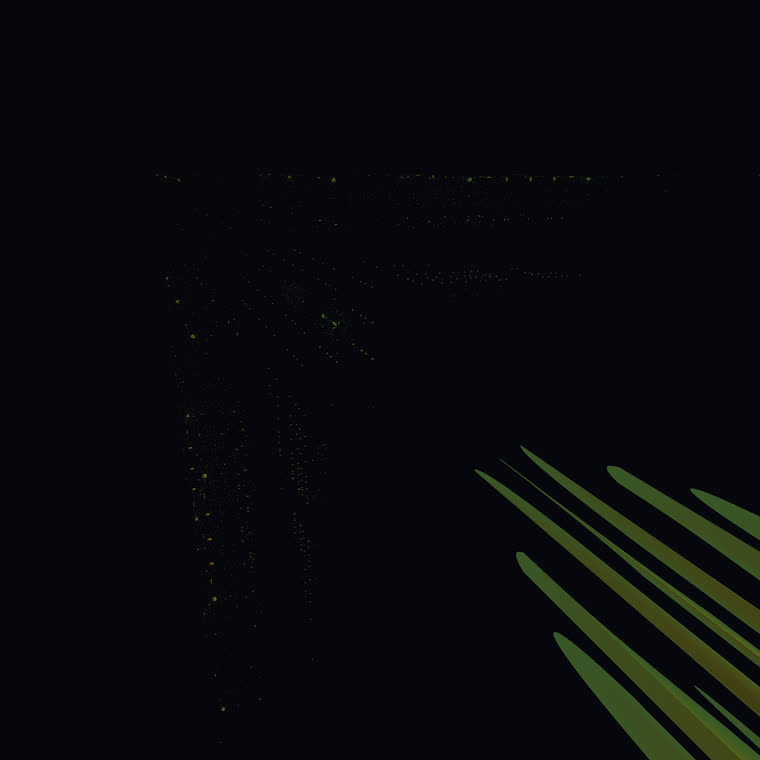
Watch it in action
assets/video/fractals/22-pseudo-kleinian.mp4
Did you know: The name nods to Indra's Pearls — a Buddhist image of an infinite net of jewels, each reflecting all the others — which is also the title of the book that made Kleinian limit sets famous.