3D fractal
KIFS tetra
Live turntable captured from Spiralyst Lab.
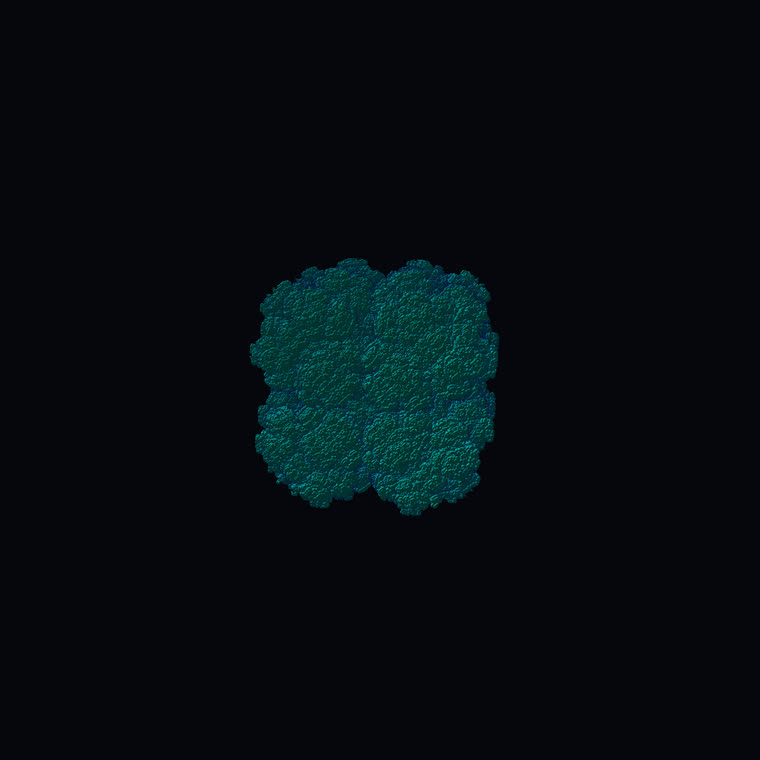
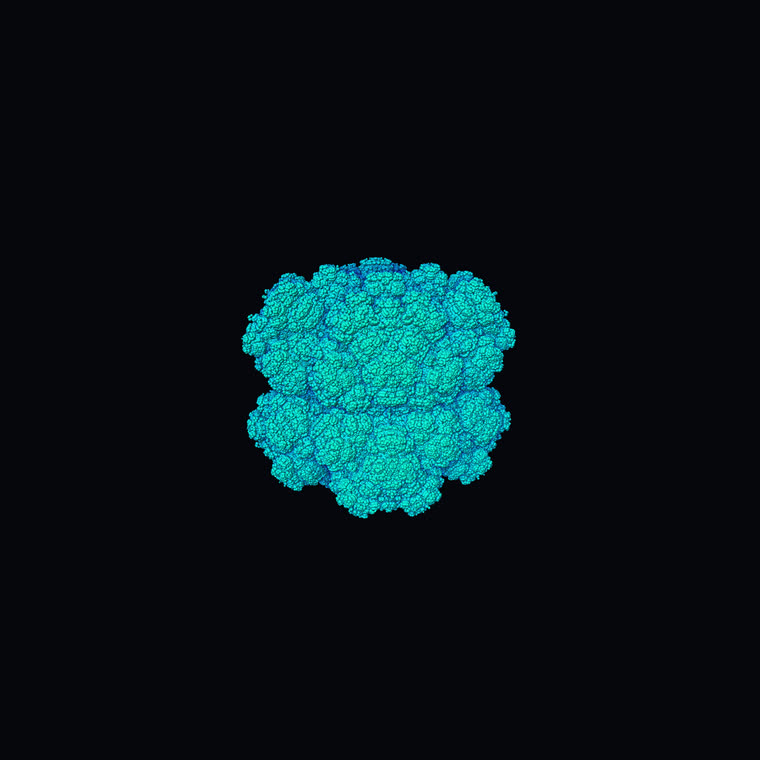
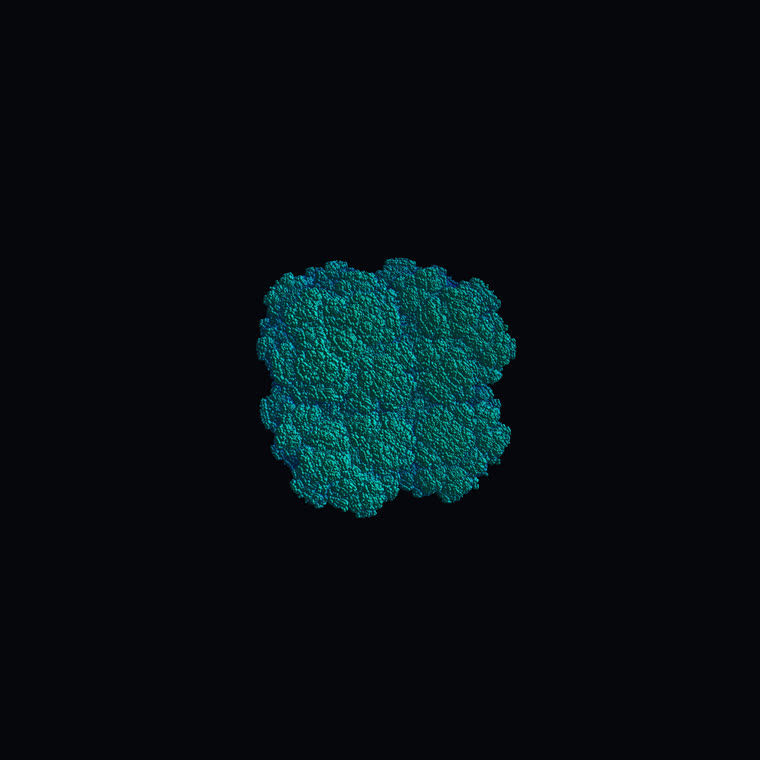
This kaleidoscopic fractal grows by folding space through mirror planes, scaling it inward, and repeating — here tuned to a four-fold tetrahedral symmetry. The effect is crystalline and snowflake-like, a structure that looks as though it grew inside a geode.
Crystals Folded from Mirrors
KIFS — Kaleidoscopic Iterated Function System — is the technique behind a whole genus of crystalline 3D fractals, popularised on the Fractalforums community around 2010. Each iteration does three things: it folds space using simple mirror reflections (taking the absolute value of coordinates folds a point into a single wedge, like a kaleidoscope), it scales the folded space toward a center, and it shifts it by an offset. Repeat a handful of times and a sharp, mineral, snowflake-like structure crystallises out.
The 'tetra' variant folds space into the fundamental wedge of tetrahedral symmetry, so the fractal inherits a four-fold crystalline character — facets and points arranged like a snowflake or a cut gem caught mid-formation. The same kaleidoscopic engine, with different scale, offset and rotation, produces the octahedral and cubic variants; the symmetry you see is really a choice of how space is folded and turned.
Like the other 3D fractals it is implicit and ray-marched, with a distance estimator that accumulates the per-step scaling so the renderer always knows how far each ray may safely advance.
Absolute-value reflections plus a sort fold every point into one fundamental wedge — the 'kaleidoscope' that imposes exact symmetry, cheaply.
After folding, scale toward a center, subtract an offset, and optionally rotate — repeat for several iterations.
The distance to a bounding sphere, rescaled by the accumulated scale over N iterations — the trick that makes KIFS renderable in real time.
In Spiralyst Lab
Spiralyst Lab uses one generic kaleidoscopic estimator (abs-fold + sort into a wedge, then scale, offset and rotate) and produces the tetra, octa and cube types by changing only the scale, offset and per-step rotations — they are presets of the same algorithm rather than three different fold geometries. Fold scale, offset and rotation reshape the crystal completely; small rotation tweaks flip it between a tight gem and an airy scaffold. The camera orbits it slowly; a tight glow gives it a faceted, gem-cut look.
Every parameter below is a live control — set it by hand, map it to a frequency band, or let it ride a smooth animation. These ranges are the actual in-app slider limits.
| Parameter | Range (in-app) |
|---|---|
| Scale | 1.5 – 3.5 |
| Offset x | 0 – 2 |
| Offset y | 0 – 2 |
| Offset z | 0 – 2 |
| Rot xz | -3.1416 – 3.1416 |
| Rot yz | -3.1416 – 3.1416 |
| Iterations | 5 – 12 |
| Surface ε | 0.0001 – 0.01 |
| Ray steps | 32 – 256 |
Audio-reactive by default: rotXZ -π→π, uScale 1.5→3.5. Any control can be mapped to audio or animation.
Plus the universal 3D controls every ray-marched type shares: camera (yaw, pitch, distance, FOV) and lighting (light direction, ambient, fog density, glow falloff).
Watch it in action
assets/video/fractals/19-kifs-tetra.mp4
Did you know: KIFS fractals were discovered largely by hobbyists on Fractalforums around 2010 — a genuine golden age in which amateurs, not academics, mapped out most of the 3D fractals in this gallery.