Blog · Release · v3.6.0 · September 18, 2026
Drawing the vortex that breaks the equations
Spiralyst Lab 3.6.0 is out, with a new 3D Flows category. It starts with the Navier–Stokes vortex — and it's in the free trial.
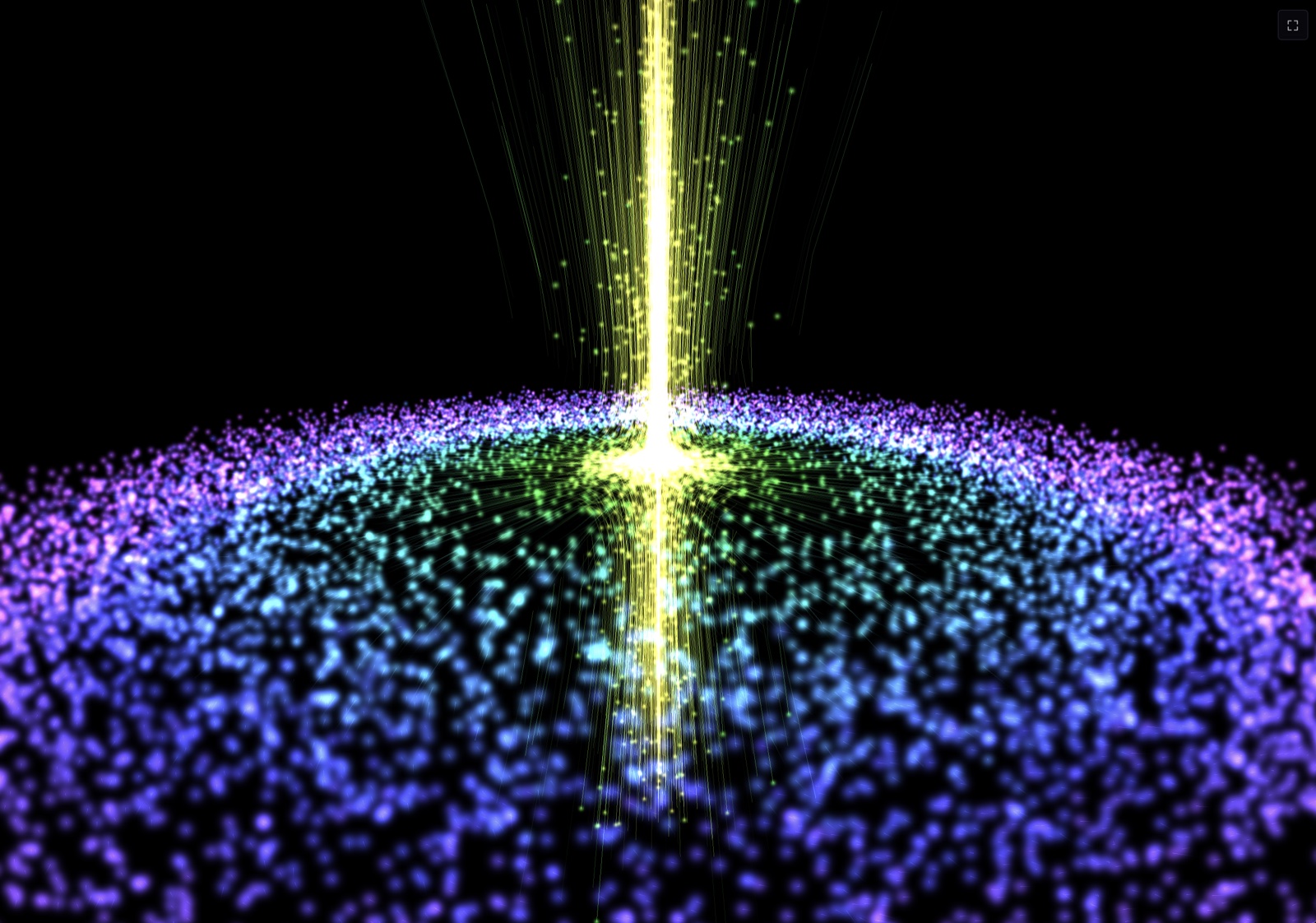
Every so often a piece of mathematics lands that you can almost see. In September 2026, one of those arrived. We are not mathematicians, and we didn't solve anything. What we did was spend a lot of time reading, checking, and asking a simple question: can we draw this honestly? This post is about what we learned, and the scene it turned into.
The question behind the picture
The Navier–Stokes equations describe how fluids move: water, air, smoke, the cream in your coffee. They're Newton's law written for every drop of a fluid. Pressure pushes, stickiness (viscosity) rubs, and the fluid can't be squeezed.
For more than a century, one question has hung over them: if you start with a smooth, calm flow, does the math always stay smooth? Or can a spot in the fluid spin up to infinite speed in a finite amount of time? It's one of the Clay Mathematics Institute's seven Millennium Prize Problems.
On September 8, 2026, OpenAI announced and published a 166-page paper, Finite Time Blowup for Navier–Stokes, with a computer-checked Lean formalization. It constructs a fluid that starts at rest and, pushed by a gentle, smooth outside force, develops unbounded speed in finite time, while the total energy stays bounded.
What it is, and what it isn't
We want to be careful here, because the headlines weren't always. As of publication:
- It's the "forced" version of the problem. The fluid gets a smooth outside push. That corresponds to the alternative sub-problems in the Clay Institute's own statement, not the headline unforced case, and OpenAI has said it does not intend to claim the prize. Whether a fluid left completely alone can blow up is still open.
- It isn't peer reviewed, and it isn't accepted. The proof is computer-verified, but the Clay Institute has not accepted it and still lists Navier–Stokes as open; its review is deliberately unhurried.
- Credit is being disputed. Mathematicians Tristan Buckmaster and Levent Alpöge posted closely related results for simpler fluid models hours before OpenAI's announcement, and there is a public priority dispute (Scientific American's coverage).
- It builds on a lot of work. That includes Terence Tao's averaged-equation blowup, the Córdoba–Martínez-Zoroa program, and Google DeepMind's discovery of unstable singularities in related equations.
If you want one readable explainer of how the construction works, Nick McGreivy's write-up is a good place to start.
The picture inside the proof
Here's the part that made us sit up: the blowup is a vortex you can picture.
Imagine water going down a drain, or a figure skater pulling in their arms.
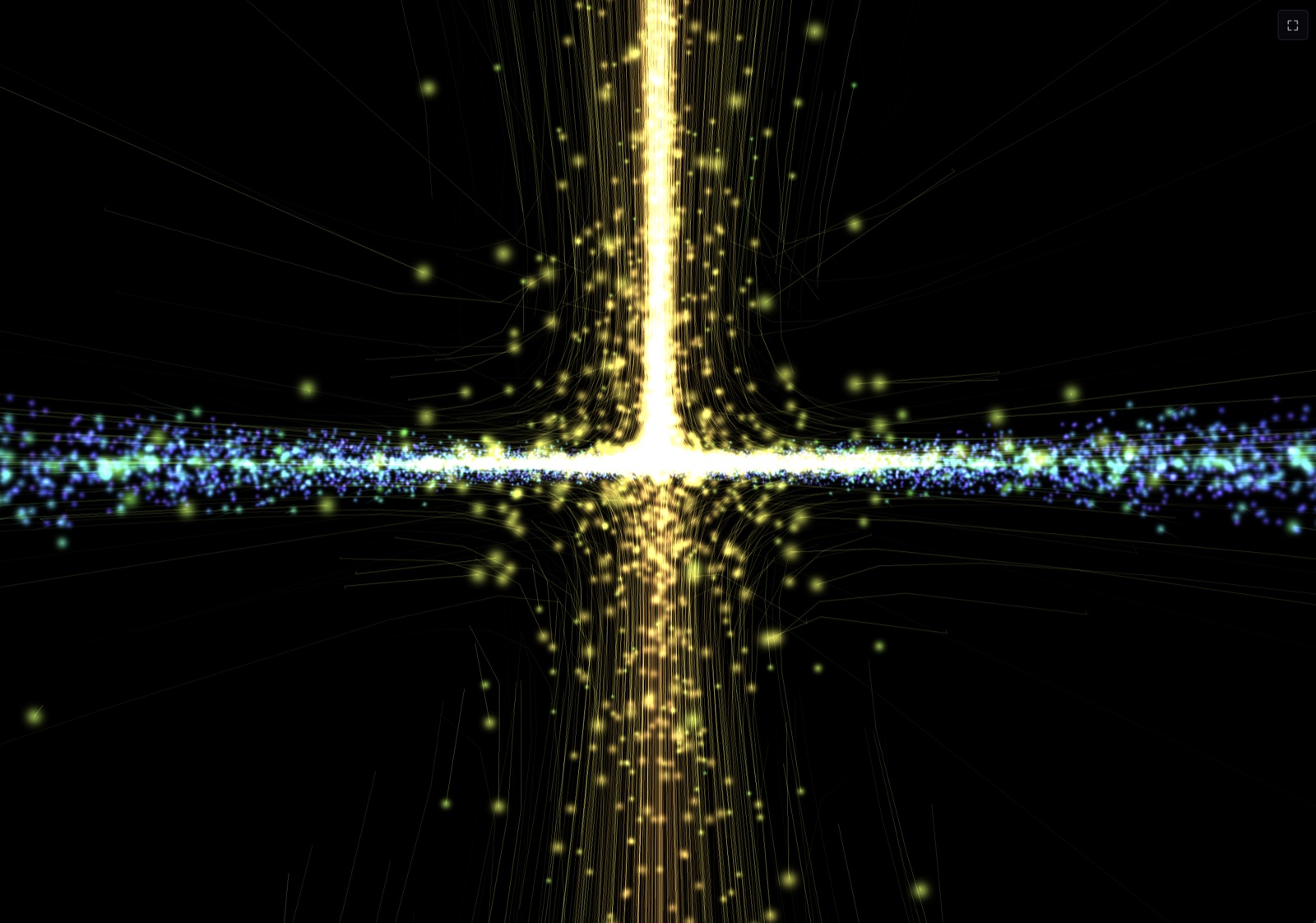
- Fluid is pulled in toward a vertical axis along a narrow waist.
- A thin sheet of it, just below the middle, spins faster and faster as it closes in.
- It can't pile up in the center, so it shoots out up and down the axis in two jets.
- As time runs out, the whole vortex shrinks toward a single point and speeds up without limit, even as the energy it carries drains away.
How we tried to draw it honestly
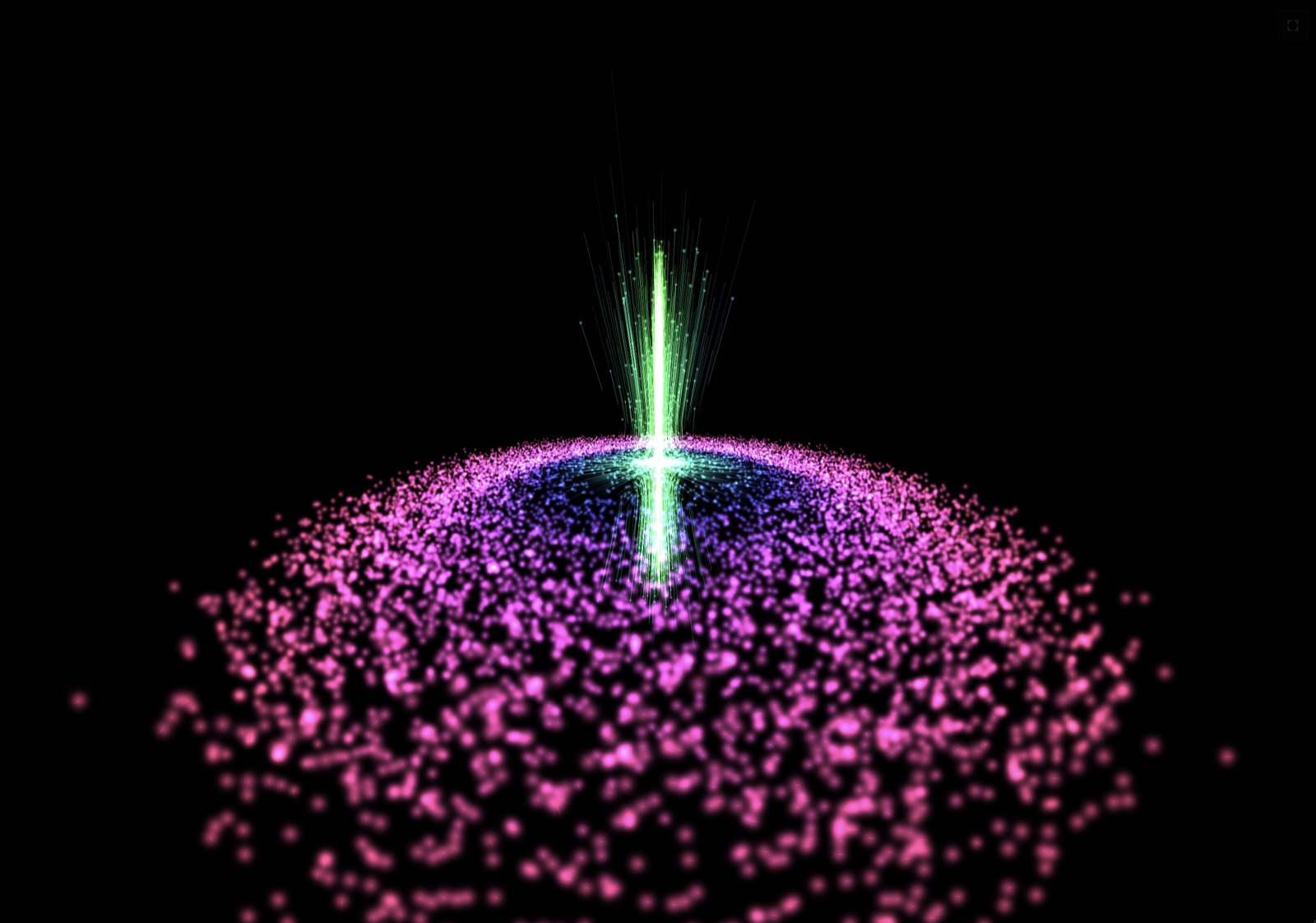
Our first prototype was pretty, but it was wrong in an interesting way: it looked like a drum. We had simplified the paper's coordinates into plain cylinders.
When we went back to the paper, we found its own coordinates make the vortex's region pinch at the middle and flare above and below, like an hourglass. Reading further into the appendices, we found the proof actually writes down much of the flow near the axis:
- a straining flow that pulls fluid in and fires it out;
- a tiny upward push;
- a swirl profile shaped like a Bessel function, the same curve that describes a vibrating drumhead.
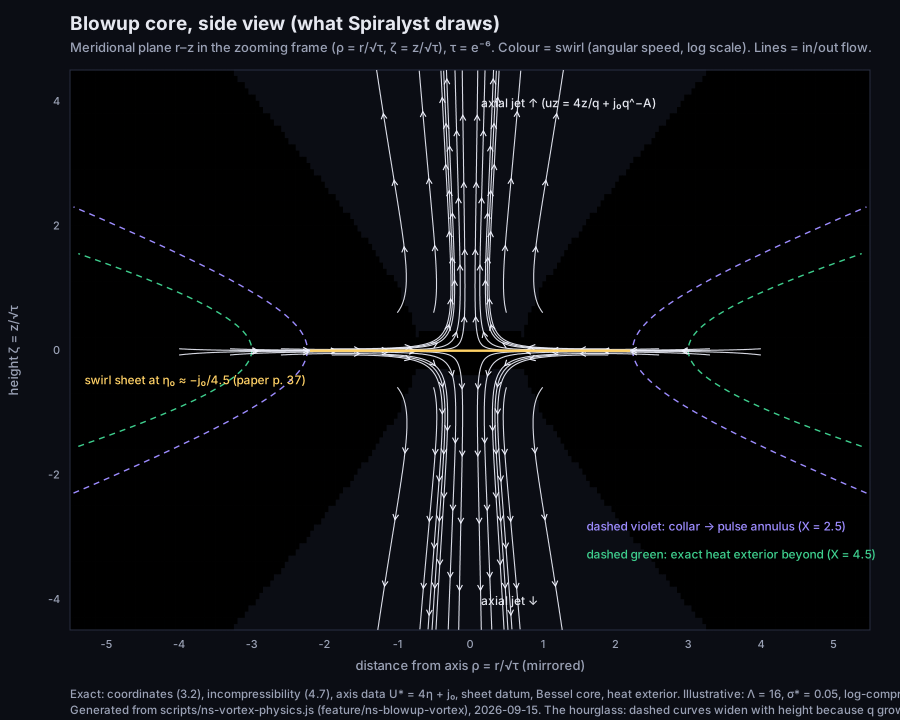
Some things the proof deliberately leaves unspecified: certain constants it only calls "sufficiently large," and distances that really span many orders of magnitude. We couldn't draw those exactly, so we didn't pretend to. Every part of the scene is labeled for what it is:
- Exact: the scaling laws, the coordinates, the near-axis flow, the outer swirl.
- Illustrative: the unspecified constants, and radii compressed to fit a screen.
- Exaggerated: only if you push a slider past the paper's range, and it says so.
- Schematic: the ripple "pulses" the proof uses to balance the flow. Their rise-and-fade timing uses the paper's exact formula — watch them breathe harder as the collapse nears — but how big and how many is a sketch, so those two are sliders.
We also checked our work the boring way, with tests. The flow can't be squeezed, and we test that; the formulas the paper gives are checked numerically, including a few deliberately wrong versions to make sure the tests can fail.
Why particles, not a fluid simulation?
A fluid simulator can't show this. Every simulation grid has a smallest cell, and a singularity keeps shrinking past any cell size you choose, so the simulator's own smoothing would blur it away. Instead, Spiralyst Lab draws the proof's flow directly and sends up to 60,000 glowing particles through it, in full 3D.
Three vortices, one lesson
The scene has three modes. Seeing them side by side is the whole lesson.
- Blowup core. The vortex from the proof: the one that breaks the equations.
- Collapsing Burgers vortex. An exact textbook solution (Gibbon, Fokas & Doering, 1999) that shrinks and speeds up at exactly the same rates. It's powered by stretching imposed from infinitely far away, so it's an analogue, not the proof's mechanism, but every number in it is exact.
- Burgers vortex. The classic whirlpool, solved live every frame, where stretching concentrates the spin and stickiness spreads it out, and the two balance forever.
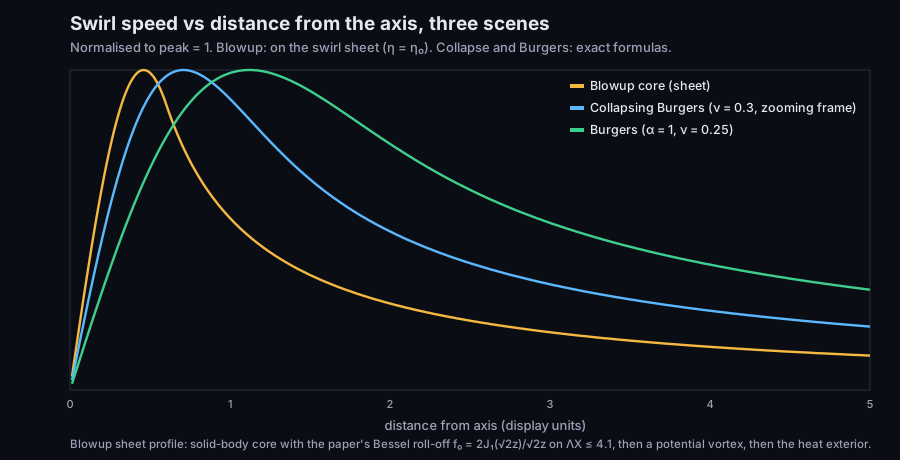
The shared idea is vortex stretching: pull a spinning column of fluid longer and it gets thinner and spins faster.
- In Burgers, viscosity catches up, and nothing breaks.
- In the collapse, an outside stretch keeps winning.
- In the blowup, the fluid's own flow does.
Made for music
This is still Spiralyst Lab, so everything moves with your music.
- Infinite zoom. The blowup vortex looks the same at every zoom level; mathematicians call that self-similar. So the default view draws nested copies of it, shrinking toward the center and fading in and out. The collapse keeps going forever, with no loop point, and it's honest to the math.
- Real physics on the beat. In the Burgers scene, bind strain to your kick drum and you watch genuine vortex stretching tighten the core, then relax. Bind the pulses to your hi-hats.
- Your look, your way. Particle shapes (soft glow, dot, ring, star, spark), trails in true 3D, "color by" speed, height, spin or distance from the axis, gradient backgrounds, and the full orbit camera.
- Every control is audio-reactive, and sliders keep their reactivity when you switch scenes.
- Math Mode, for the curious. Open it for the live equations, an info card on the research with a plain-English guide to every control — and now the card reads itself aloud, section by section.
It isn't alone: the waterfall
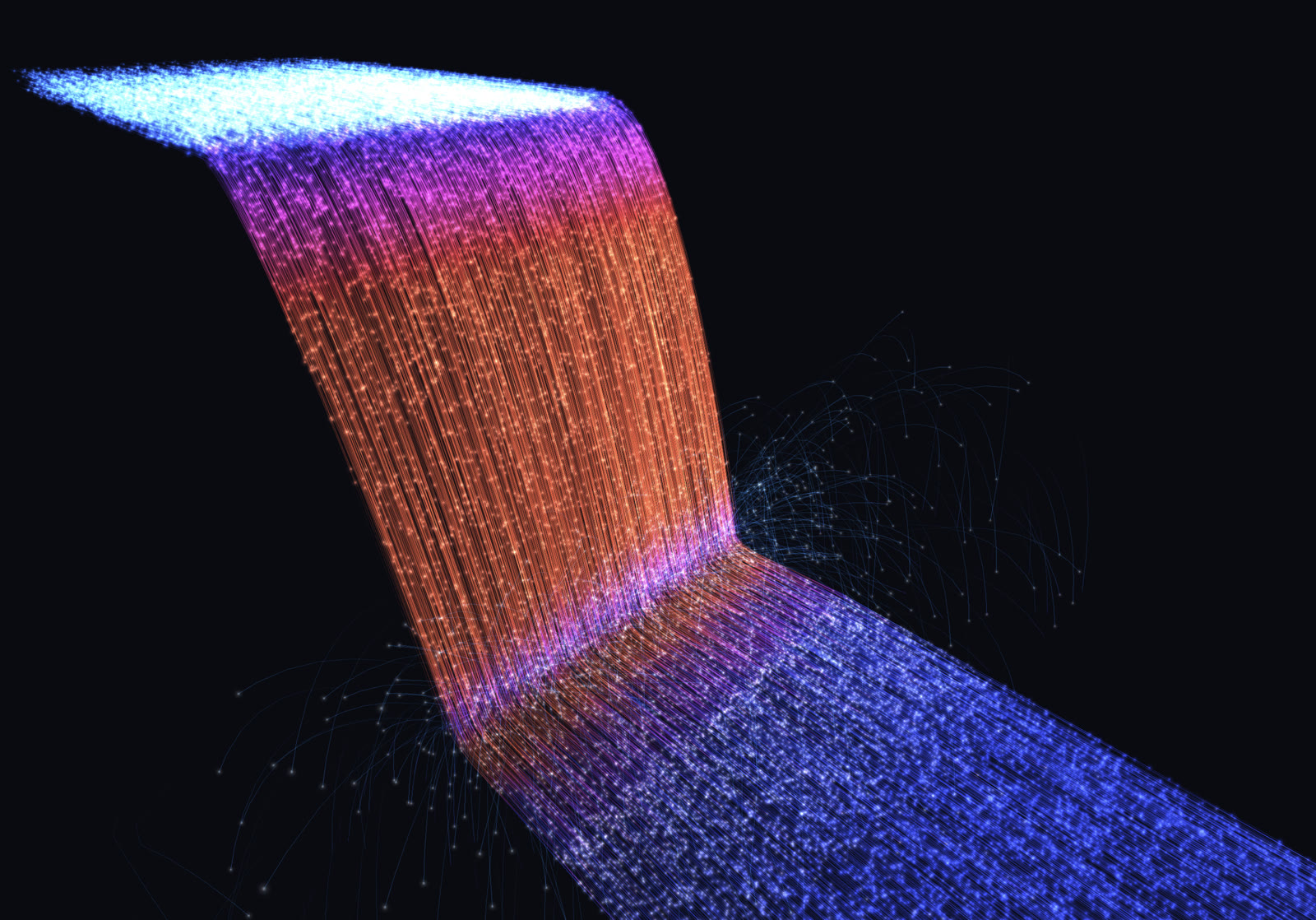
3D Flows is a category, and the second scene takes the same approach to something you've stood next to. The waterfall isn't drawn — it's solved: the river draws down toward the lip, the sheet thins as it falls, the water lands and throws up a hydraulic jump whose whole character (glassy, rolling, or a standing wall of foam) is computed from the fall height and flow you set, in real units. Turn the tailwater up and the jump drowns; drive the flow with your bass and the whitewater marches. It's a paid-scene companion to the vortex, and it gets its own post.
Big scenes, honest frame rates
Sixty thousand particles is a lot of work for a laptop, so 3.6.0 also adds a plain choice in the Quality group: Safe mode holds your frame rate — trimming particle count or resolution when a frame runs long, and telling you so in the control panel — and Full power renders exactly what the sliders say. And if your MacBook's Low Power Mode is on, the app now says so, because that one setting changes what you see more than any slider does.
Learning out loud
We built this because a frontier result deserved a picture that respects it: one that shows the beauty without overselling the math. If you're a mathematician or physicist and you spot something we got wrong, we genuinely want to hear it. That's how the next version gets better.
And if you just want to watch a vortex fall into itself to your favorite track, that's exactly what it's for — and you can, in the free trial, right now.
How to get it
New here? Spiralyst Lab 3.6.0 is available now for macOS 14.4+. The Navier–Stokes vortex is included in the free trial; a year of everything is $24.99, direct download from spiralyst.com.
Already a customer? 3.6.0 is included in your annual license. Grab the latest build from spiralyst.com/download and replace your copy.