
3D Flow
Five Problems in a Row
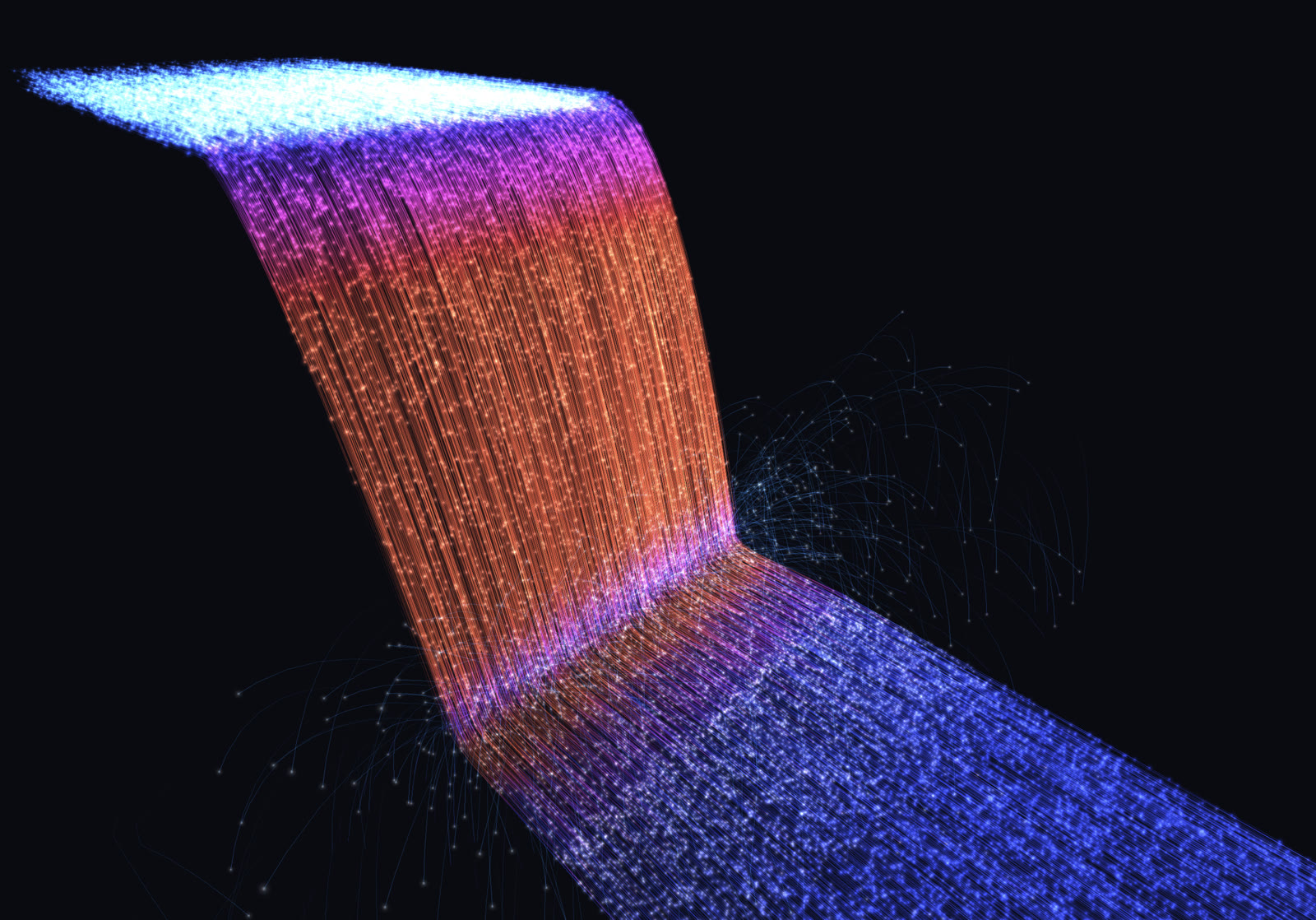
The waterfall, coloured by speed: slow blue river, the sheet warming to orange as it falls, the pool below.
A waterfall, solved rather than drawn. The river draws down toward the lip, the sheet thins as it falls, and where it lands it makes a hydraulic jump whose violence is computed from the flow itself — not chosen for looks.
Watch water go over an edge and you are watching five separate pieces of physics hand off to each other. Each one has been measured and written down, some of them a very long time ago, and chaining them together is enough to build a waterfall you can trust.
First the approach river. As the water nears the drop it speeds up and its surface sags — engineers call this an M2 drawdown, and it comes from the gradually-varied-flow equation, which balances the push of the bed's slope against the drag of its roughness. Right at the lip the flow passes through what is called critical depth, and the depth there settles at 0.715 of it. Hubert Rouse measured that fraction in 1936, and it is stable enough that you can measure a stream's flow with nothing but a ruler at the edge of a waterfall.
Then the fall itself, which is just a thrown object. The sheet thins as it drops, because the same amount of water has to pass every height, so faster means thinner. That is why a nappe is a broad ribbon at the top and a narrow, fast veil near the bottom.
Last, the landing. Fast shallow water meeting slower deep water cannot do so gently: it jumps. Jean-Baptiste Bélanger worked out the new depth in 1841 from conservation of momentum, and the Bureau of Reclamation later sorted the results into five kinds of jump by a single number, the Froude number. Below 1.7 you get a ripple. Between 4.5 and 9 you get the well-behaved whitewater stilling basins are designed around. Above 9 the jump turns violent and eats up to 85 percent of the energy arriving. So how frothy this pool looks was never an artistic decision — it follows from how much water is falling and how far.
A note on honesty. The equations, the depths and the trajectory are exact. The published constants — the 0.715, the pool-shape correlations, the air-entrainment ratio — are measurements, quoted from the papers, and the scene flags when a setting pushes them outside the range they were measured in. The mist, the foam and the way particles swirl inside the roller are drawings. The approach river is really about ten times longer than the fall is tall, so it is compressed to fit the frame, and the info bar tells you the scale.
The Math
$$\frac{dh}{dx} = \frac{S_0 - S_f}{1 - \mathrm{Fr}^2}, \qquad S_f = \frac{n^2 V^2}{R_h^{4/3}}$$
The gradually-varied-flow equation with Manning's friction. It says how the water surface rises or falls along the channel, balancing the slope of the bed against the drag of its roughness. Approaching a drop on a gentle slope it produces the drawdown you see near the lip.
$$h_c = \left(\frac{q^2}{g}\right)^{1/3}, \qquad d_b = 0.715\, h_c$$
Critical depth, where the water travels exactly as fast as a ripple can, and the depth at the brink, which is measurably shallower because the streamlines curve over the edge and the air underneath pushes back. The 0.715 is Rouse's 1936 measurement.
$$\delta(z) = \frac{q}{\sqrt{V_b^2 + 2 g z}}, \qquad t_f = \sqrt{\frac{2H}{g}}$$
The falling sheet. Gravity fixes the speed after any drop, and because the same discharge passes every height, thickness is just discharge divided by speed. The sheet thins as it accelerates.
$$\frac{d_2}{d_1} = \frac{1}{2}\left(\sqrt{1 + 8\,\mathrm{Fr}_1^2} - 1\right), \qquad \mathrm{Fr}_1 = \frac{V_1}{\sqrt{g d_1}}$$
Bélanger's equation, from conservation of momentum across the hydraulic jump: given the fast shallow water arriving, it gives the depth of the slow deep water leaving. Energy is not conserved here, which is exactly why a jump is so turbulent.
$$\Delta E = \frac{(d_2 - d_1)^3}{4\, d_1 d_2}, \qquad L_r = 8\,(\mathrm{Fr}_1 - 1.5)\, d_1$$
How much energy the jump destroys, and how long its surface roller is. Together these say how much whitewater to draw and how far downstream it reaches — both computed, neither chosen.
How Spiralyst Lab draws it
Spiralyst Lab does not run a fluid simulation. It solves the chain once — the drawdown profile, the brink, the trajectory, the jump and the outflow — and then sends up to sixty thousand particles along the answer, in full 3D on the same orbit camera as the fractals. Each stage moves the particles by its own formula: the river and the outflow ride the solved depth profile, the falling sheet is a projectile, the roller turns over with its surface running back upstream, and spray is a droplet with air drag. The solve only re-runs when a physical control moves, so audio can drive any slider without cost. Every control is audio-reactive, the slider guide describes each one, and everything drawn is labeled exact, measured, illustrative or schematic.
Requires a Spiralyst Lab license.
Did you know?
You can measure a stream's flow rate with nothing but a ruler held at the edge of a waterfall. The depth right at the lip is always about 0.715 of the critical depth, so the depth alone tells you the discharge — a trick hydrologists have used since 1936.
Get Spiralyst Lab — $24.99/yr 3D Flows overview ← All gallery
Math typesetting on this page is rendered by KaTeX 0.17.0 (MIT).