2D fractal
Fractal phyllotaxis
Live turntable captured from Spiralyst Lab.
Fractal phyllotaxis nests one golden-angle seed head inside another, so every seed of the outer pattern becomes the center of its own miniature seed head. The eye reads it as impossibly dense organic detail — clusters within clusters, all obeying the same 137.5° rule.
Seed Heads Within Seed Heads
Phyllotaxis is already one of nature's most efficient patterns; nest it inside itself and it becomes a fractal-flavoured one. In fractal phyllotaxis, an outer golden-angle seed head is laid down first, and then at the position of every outer seed a second, smaller golden-angle seed head is stamped. The eye reads the result as impossibly dense organic detail — clusters within clusters, all obeying the same single rule of 137.5°.
Both levels use the golden angle, each with its own slight detuning, and the inner clusters are sized to nestle into the spacing of the outer pattern. Because the golden angle never lets points repeat, the nested clusters interleave instead of colliding, and the overall texture stays smooth and gap-free at both scales.
It is two of nature's favourite tricks stacked on top of each other: optimal golden-angle packing, and self-similar nesting. The effect is a seed head that rewards looking closer — a sunflower whose every floret is itself a tiny sunflower.
A standard Vogel phyllotaxis for the outer field of points, with the golden angle ψ ≈ 137.508°.
Each outer seed becomes the center of its own scaled Vogel phyllotaxis; the inner cluster also rotates with the outer angle so neighbouring clusters mesh.
In Spiralyst Lab
Spiralyst Lab implements this as a deliberate two-level nesting rather than unbounded recursion: an outer phyllotaxis of up to a few hundred points, each carrying a small inner phyllotaxis whose radius is derived to fit the outer spacing. Inner-cluster size, point counts and a per-level angle drift are the controls; the point budget is capped so even dense nests stay smooth. It is a showpiece for slow hue animation over a high-density field.
Every parameter below is a live control — set it by hand, map it to a frequency band, or let it ride a smooth animation. These ranges are the actual in-app slider limits.
| Parameter | Range (in-app) |
|---|---|
| Outer count | 30 – 250 |
| Inner count | 10 – 100 |
| Inner size | 0.02 – 0.18 |
| Inner drift | -0.01 – 0.01 |
Audio-reactive by default: innerScale 0.03→0.16, driftInner -0.01→0.01. Any control can be mapped to audio or animation.
Plus the universal 2D controls every spiral type shares: density & stroke, rotation, squash, jitter, zoom & pan, glow, trails, vignette, and multi-layer stacking (count, hue offset, opacity).
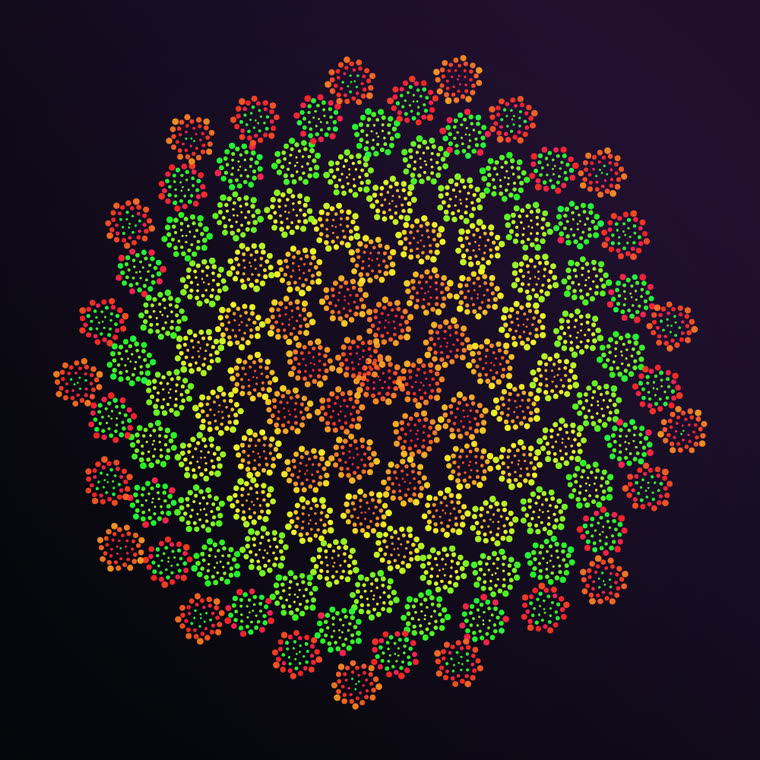
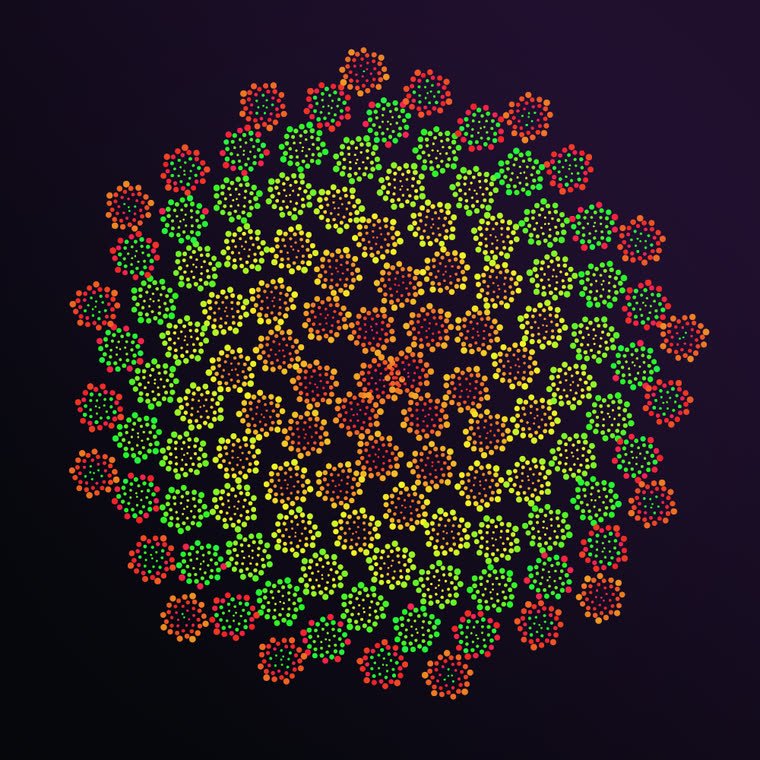
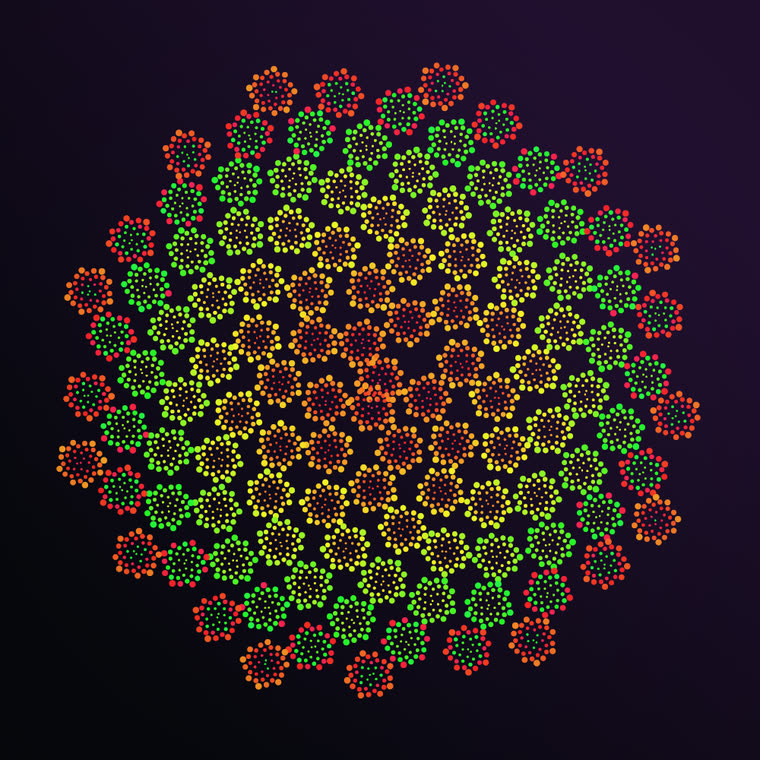
Watch it in action
assets/video/fractals/08-fractal-phyllotaxis.mp4
Did you know: This is what mathematicians call self-similarity meeting optimal packing — and it is roughly how the florets of a real composite flower (think a daisy's center) are organised at two scales at once.