
2D fractal
Fractal rose
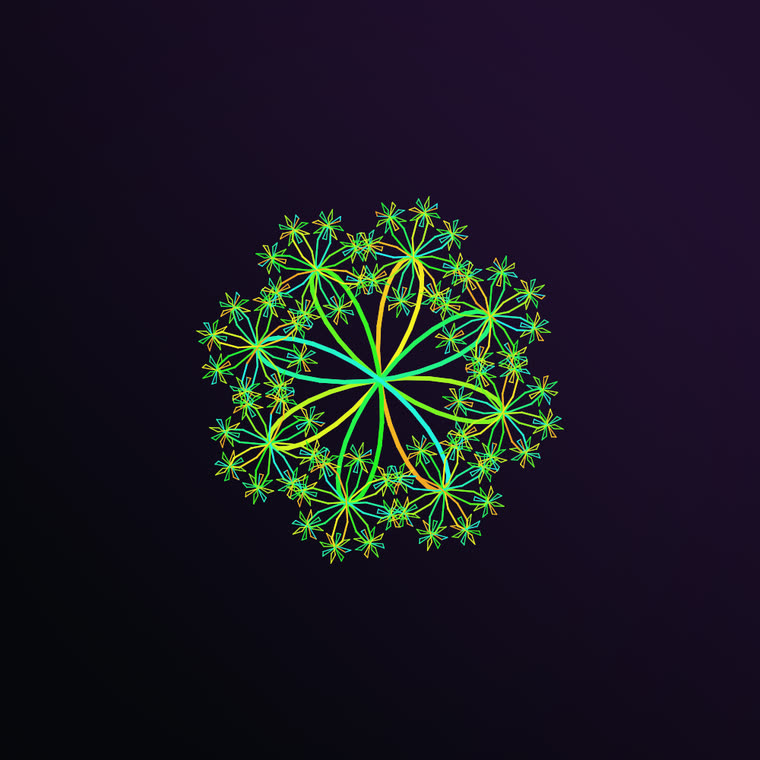
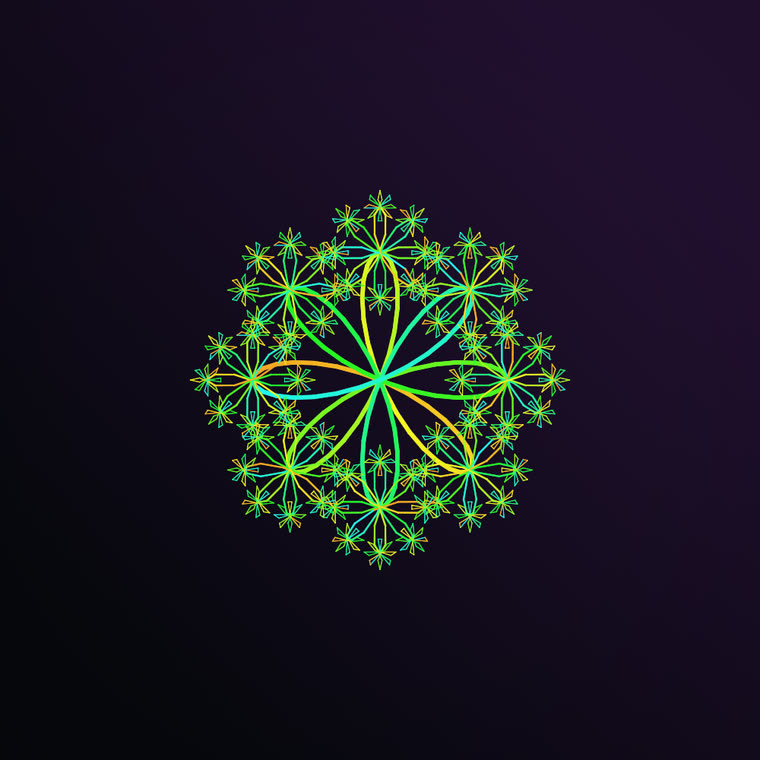
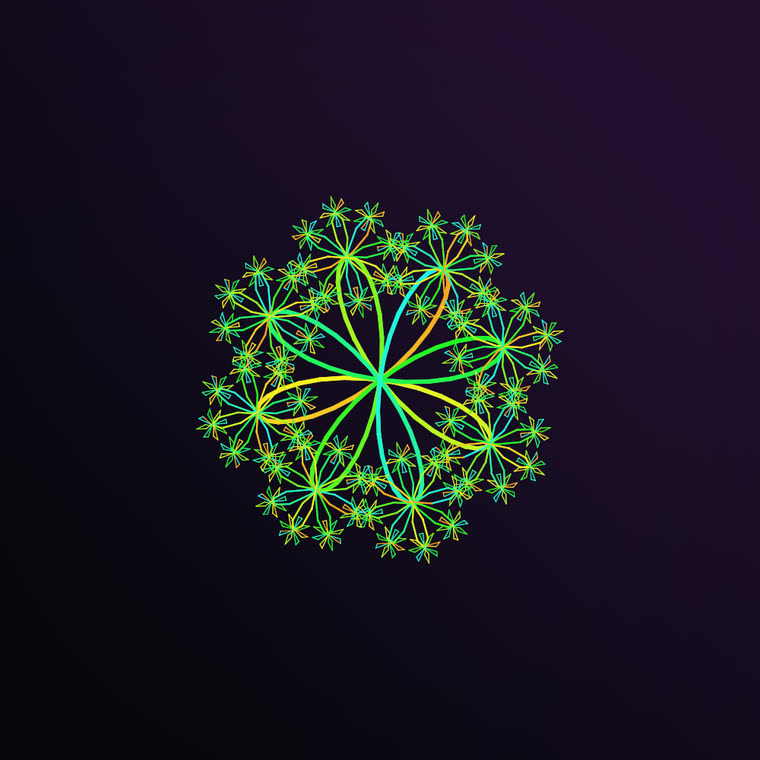
Live turntable captured from Spiralyst Lab.
The fractal rose makes a true rose curve recursive: at the tip of every petal it sprouts a smaller rose, and a smaller one on each of those, down through several generations. The result is a self-similar bouquet that keeps blooming the closer you look.
A Bouquet That Never Stops Blooming
Where the coiled Rose type bends a rose into a spiral, the Fractal Rose makes the rose recursive. It draws a genuine rhodonea — the textbook r = cos(kθ) — and then, at the tip of every petal, sprouts a smaller copy of the whole rose, scaled down and rotated. At the tip of each of those, a smaller rose still, down to a chosen depth. The result is a self-similar floral fractal, a bouquet that keeps blooming as you look closer.
Unlike the coiled type, this one uses the pure mathematical rose, so the classic parity rule applies: an odd petal count k gives k petals, an even k gives 2k. Each generation is placed exactly at the parent's petal tips — the rose's points of maximum radius — so the recursion grows outward along the flower's natural extremities, branching into a lattice of nested blooms.
It is the rose curve's answer to a fern or a head of Romanesco broccoli: ornamental recursion, the same shape repeating at shrinking scale, built from nothing but a cosine and a rule to repeat.
The true rhodonea (rose) curve. k odd → k petals; k even → 2k petals — the textbook parity, faithfully used here.
Recursion: every petal tip becomes the origin of a child rose scaled by a shrink factor s < 1 and rotated by a fixed twist, repeated to the chosen depth.
In Spiralyst Lab
Spiralyst Lab grows the recursion to your chosen depth — child scale ('shrink') and a per-level 'twist' shape how tightly the bouquet curls — and colours by generation so the nested roses fade through the palette as they shrink. Recursion stops at a minimum size or a point budget, keeping deep bouquets responsive. Animate the petal count for a mesmerising, breathing arrangement.
Every parameter below is a live control — set it by hand, map it to a frequency band, or let it ride a smooth animation. These ranges are the actual in-app slider limits.
| Parameter | Range (in-app) |
|---|---|
| Petals (k) | 3 – 6 |
| Child scale | 0.22 – 0.48 |
| Twist | -1.5 – 1.5 |
Audio-reactive by default: rotInc -1.2→1.2 (twist), shrink 0.22→0.48. Any control can be mapped to audio or animation.
Plus the universal 2D controls every spiral type shares: density & stroke, rotation, squash, jitter, zoom & pan, glow, trails, vignette, and multi-layer stacking (count, hue offset, opacity).
Watch it in action
assets/video/fractals/09-fractal-rose.mp4
Did you know: Recursive flowers like this are close cousins of L-systems, the formal grammars Aristid Lindenmayer invented in 1968 to model how real plants grow — the same idea behind the ferns and trees in computer-graphics landscapes.