2D fractal
SVG Fractal
Live turntable captured from Spiralyst Lab.
The SVG fractal takes any outline — a star, a logo, your own mark — and recursively replaces each of its edges with a small fractal generator, so the boundary grows infinitely detailed. It is the machinery behind the Koch snowflake, and the route to turning your own artwork into a fractal.
Any Edge, Made Infinite
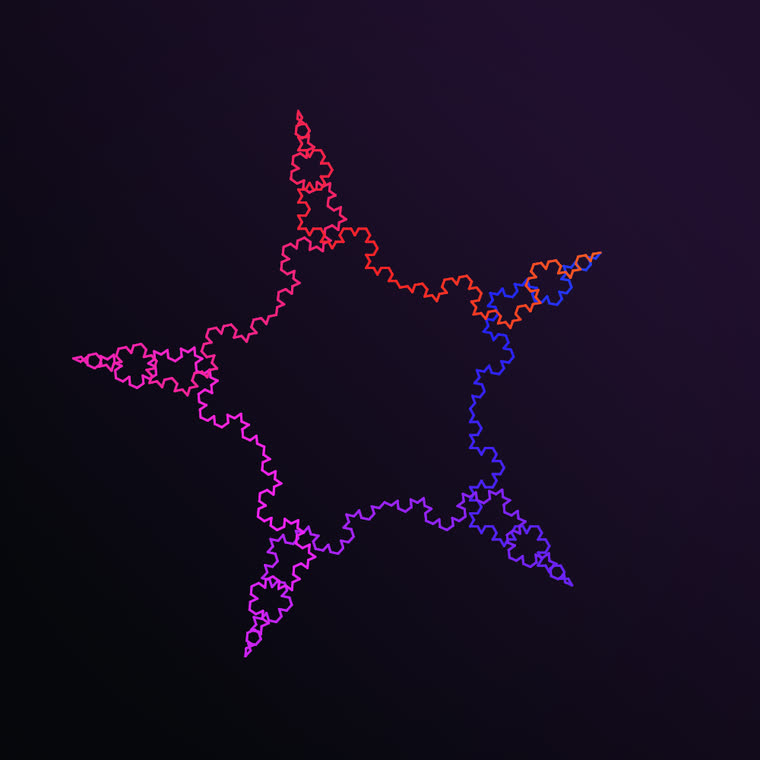
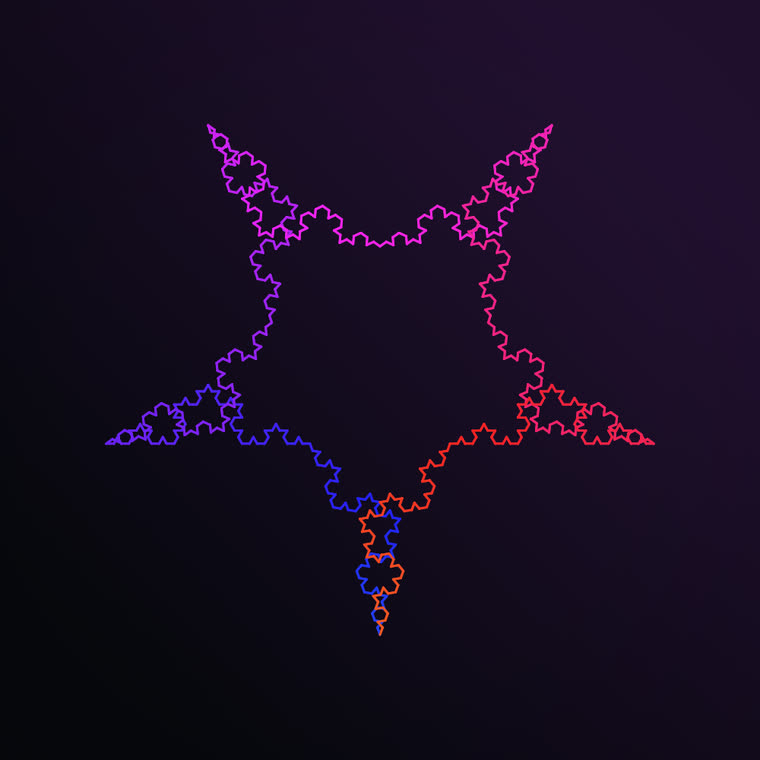
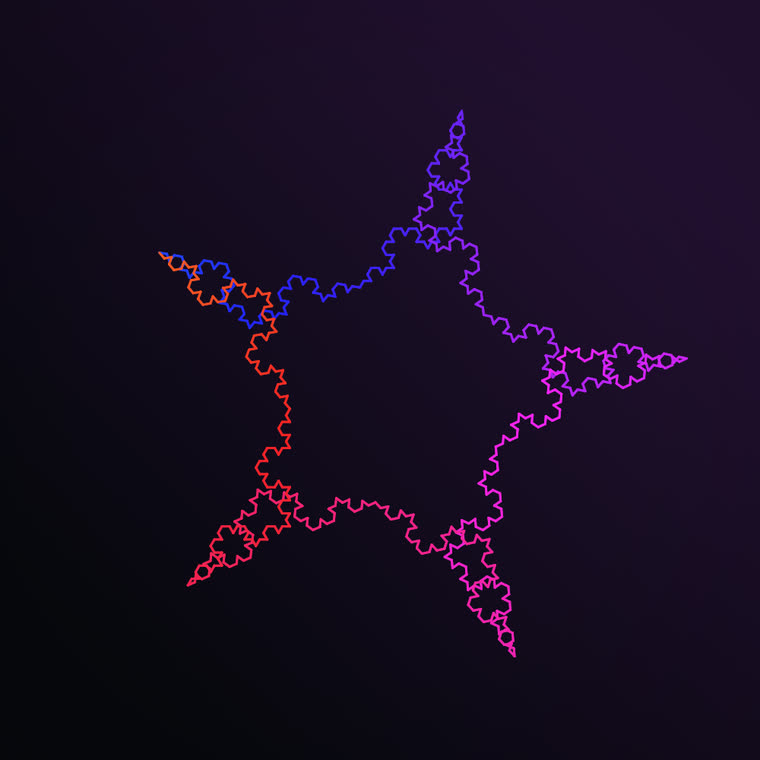
This is the open-ended, bring-your-own-shape fractal. Start with any outline — the gallery uses a five-point star — and replace each of its straight edges with a small, scaled copy of a 'generator' rule. Do it once and the outline grows bumps; do it again and each new edge grows its own bumps; repeat and the boundary becomes infinitely detailed. This edge-substitution scheme is the machinery behind the Koch snowflake (1904), one of the earliest fractals ever described, and a whole family of related curves.
Different generator rules produce wildly different textures from the same seed. The Koch rule replaces each edge with four segments that poke out a triangular peak, giving a fractal dimension of about 1.262 — rougher than a line but far from filling the plane. The Lévy C-curve rule pushes that dimension close to 2, almost plane-filling. Square-notch, inward-Koch (gear-like teeth), Cesàro (a tunable Koch), Chaikin smoothing, and zigzag rules round out the set, each changing the angle and number of replacement segments and, with them, the roughness.
Because the seed is any vector path, this is also the route to branded fractals: feed it your logo, monogram or mark and watch your own artwork sprout fractal detail along its edges — and because it stays vector under the hood, the result can be exported as a crisp, infinitely scalable SVG.
The de Rham / edge-substitution scheme: every straight segment is replaced by the chosen rule's vertices, and the process repeats to the selected depth.
The classic rule. Other built-in rules (Cesàro, Lévy-C, square-notch, inward, zigzag, Chaikin-smooth) change the segment count and angle, and with them the texture and dimension.
Nearly plane-filling — the same machinery, a radically different result, just by swapping the generator.
In Spiralyst Lab
Spiralyst Lab parses an SVG silhouette into boundary polylines, applies the chosen generator rule a set number of times (one to seven), then strokes the result — staying vector throughout, so it exports cleanly to SVG. Seven rules ship (Koch, Cesàro, smooth, Lévy-C, square-notch, inward-Koch, zigzag) plus a library of seed shapes, and you can import your own. One honest note: the Koch-style bump direction is winding-agnostic, so on closed shapes peaks may point inward or outward depending on the traversal.
Every parameter below is a live control — set it by hand, map it to a frequency band, or let it ride a smooth animation. These ranges are the actual in-app slider limits.
| Parameter | Range (in-app) |
|---|---|
| Preset | None – None |
| Rule | 0 – 6 |
| Iterations | 1 – 7 |
| Rule param | 10 – 170 |
Audio-reactive by default: depth 1→5, ruleParam 20→160. Any control can be mapped to audio or animation.
Plus the universal 2D controls every spiral type shares: density & stroke, rotation, squash, jitter, zoom & pan, glow, trails, vignette, and multi-layer stacking (count, hue offset, opacity).
Watch it in action
Did you know: The Koch snowflake encloses a finite area with an infinitely long boundary — you could never finish tracing its edge, yet the whole thing fits on a coaster.