
2D fractal
Julia set
Live turntable captured from Spiralyst Lab.
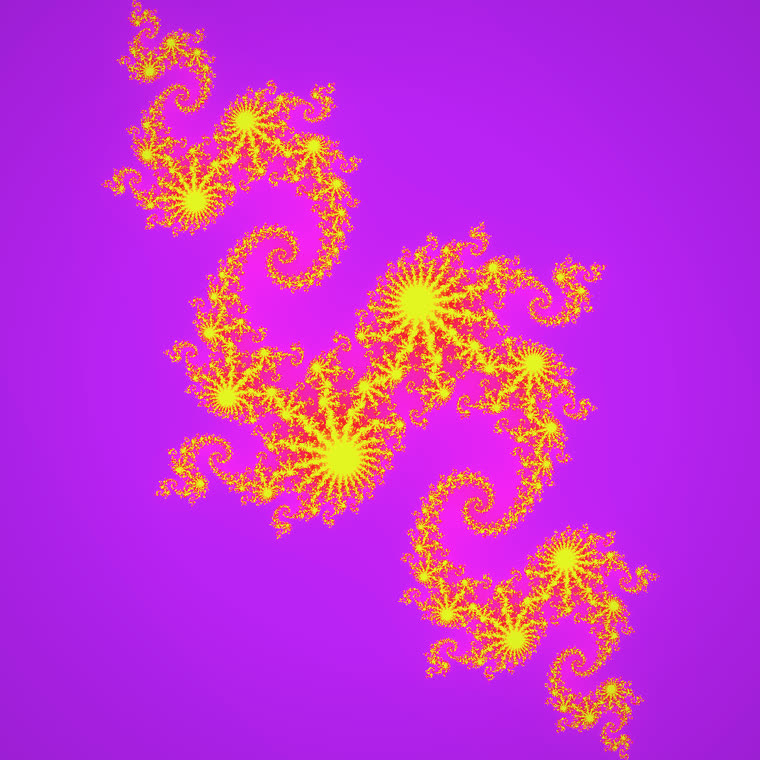
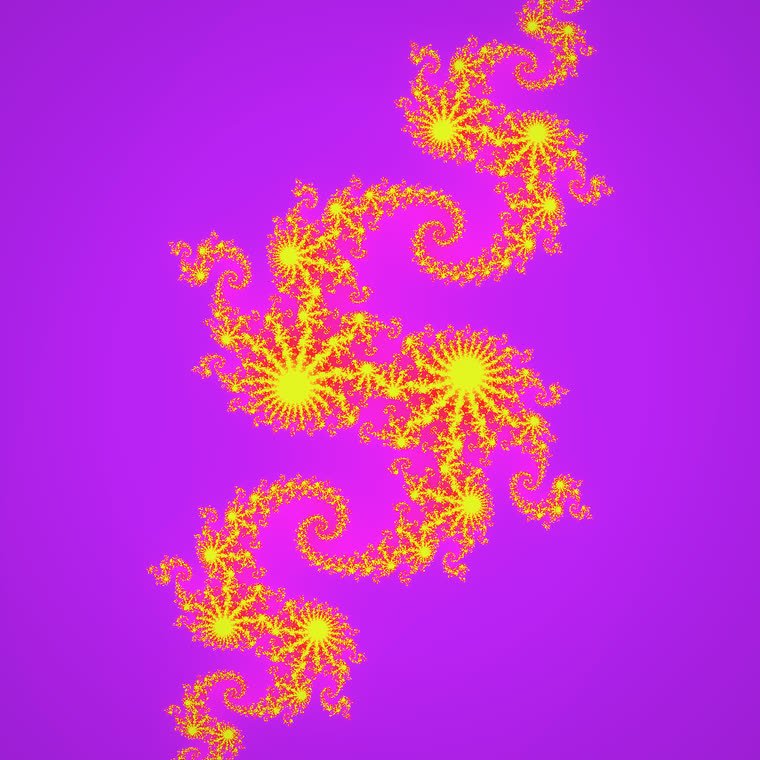
The Julia set is the boundary between the points that fly off to infinity and the points that stay trapped when you repeatedly square a number and add a fixed constant. A tiny change to that constant transforms the whole shape — from tight spirals to branching lightning to scattered dust.
One Rule, a Whole Universe
The Julia set is where a single line of arithmetic becomes a universe. Fix a complex number c. Then take a starting point in the complex plane and repeatedly square it and add c. Some starting points fly off to infinity under this iteration; others stay bounded forever. The boundary between those two fates — escape and capture — is the Julia set, named for Gaston Julia, who studied these objects in 1918, decades before computers could draw them.
The magic is how sensitively the shape depends on c. Change c by a hair and the whole set transforms: tight spirals, branching lightning (dendrites), scattered dust, or a single connected blob. There is a deep link to the Mandelbrot set here — the Julia set is one connected piece exactly when its c lies inside the Mandelbrot set, and shatters into disconnected dust when c lies outside. In fact, the Julia sets you get by sweeping c around the edge of the Mandelbrot set are tiny portraits of the Mandelbrot's local shape at that point; the two famous fractals are secretly the same object seen two ways.
It is the original poster child of fractal art — the image that, once colour computers could render it in the 1980s, convinced a generation that mathematics could be beautiful.
The entire rule, iterated on each pixel's complex coordinate z. The constant c is fixed for a given image and selects which Julia set you are looking at.
How the colours arise — each point is shaded by how many iterations it survives before its magnitude crosses the escape radius of 2. Points that never escape get the interior colour.
A profound dichotomy: the Julia set is a single connected piece exactly when its c lies in the Mandelbrot set; outside it, the set is totally disconnected dust.
In Spiralyst Lab
Spiralyst Lab renders the Julia set per-pixel at native resolution: each pixel's coordinate is z₀, c is fixed for the frame, and the iteration z → z² + c runs until |z| exceeds 2 or the iteration cap is reached, with the surviving count indexing the palette (classic discrete escape-time bands — no smooth shading). The constant c is the soul of the image; in the gallery it is animated (c real −1.0→0.4, c imaginary −0.6→0.6) so the set morphs continuously — ideal to drive with audio.
Every parameter below is a live control — set it by hand, map it to a frequency band, or let it ride a smooth animation. These ranges are the actual in-app slider limits.
| Parameter | Range (in-app) |
|---|---|
| c real | -1.2 – 1.2 |
| c imag | -1.2 – 1.2 |
| Iterations | 20 – 250 |
| Complex zoom | 0.3 – 5 |
Audio-reactive by default: cRe -1.0→0.4, cIm -0.6→0.6. Any control can be mapped to audio or animation.
Plus the universal 2D controls every spiral type shares: density & stroke, rotation, squash, jitter, zoom & pan, glow, trails, vignette, and multi-layer stacking (count, hue offset, opacity).

Watch it in action
assets/video/fractals/14-julia.mp4
Did you know: Gaston Julia worked all this out in 1918 — having lost his nose to a WWI injury, he wrote his foundational paper at age 25. He never saw one of his sets rendered; the first computer images came half a century later.